Musings from Brian J. Noggle
Saturday, February 07, 2009
Good Book Hunting: January 2009
You think that because I haven't posted a good book hunting segment in a while that I have not been out there buying books? Hah! Think again.
Although January isn't normally a good month for book fairs, this January 2009 proved to be fruitful indeed. We visited the following three book fairs.
St. Michael's
The first book fair we visited was St. Michael's in Shrewsbury. I think we missed this book fair last year; however, we saddled up our children and went to this one (a side benefit of having toddlers as big as horses is you can, in fact, ride them). St. Michael's is tucked off a side street in Shrewsbury (St. Michael, for some reason). Here it is:
View Larger Map
The book fair is tucked into a small room to the left of the entrance. Small rooms with few people mean that toddling children can walk by themselves, exploring the books on their own. Our toddling child offers his own suggestions for purchase, not only in children's books but also in adult books, but his determinations of his parents' reading interests are more random than an Amazon algorithm. At any rate, here's what we got:
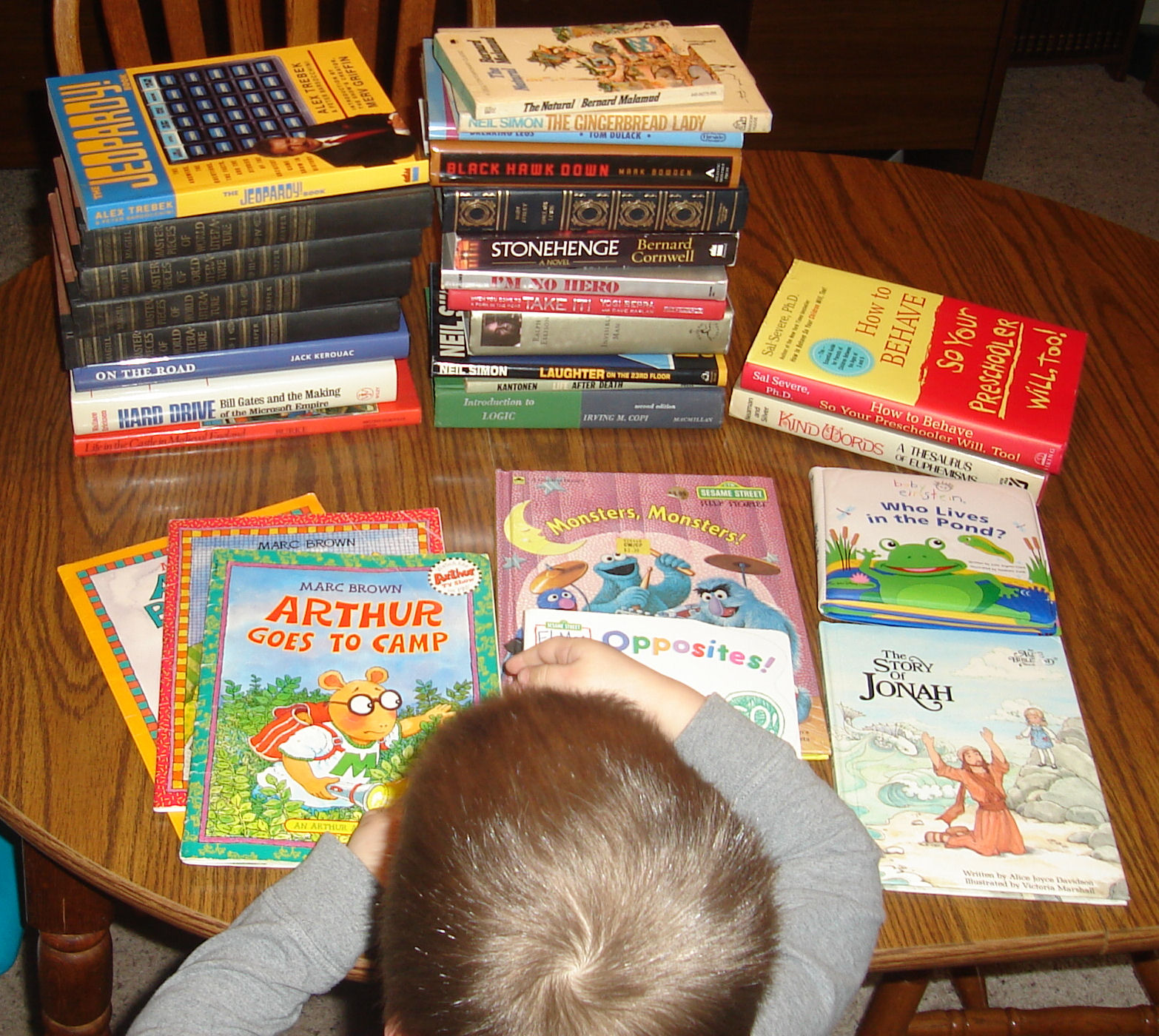
Click for full size
I got:
- The Jeopardy Book, a book based on the popular television game show.
- A four volume set of Masterpieces of World Literature, a reference work.
- On the Road by Jack Kerouac in bound, not scroll, form.
- Hard Drive, a book about Bill Gates and Microsoft. I'll read it sometime, like I'll read Softwar about Larry Ellison and Oracle sometime.
- Life in the Castle in Medieval England. Self-explanatory.
- The Natural, the book upon which the movie was based.
- Breaking Legs, a play.
- Blackhawk Down, the book about the Somalian excursion. I read the book serialized in the late 1990s, but I'll probably want to read it again. You know, I think I saw the film, too.
- Main Street by Sinclair Lewis.
- Stonehenge by Bernard Cornwell. It doesn't fit into the Sharpe series, so I didn't blow it with all the people who will get me the series for my birthday.
- I'm No Hero. I forget who wrote this, or why he or she bothered to assert it. I guess I'll find out sometime in 2019, unless I'm forced to burn the book for fuel first.
- If You Come To A Fork In The Road, Take It, a memoir by Yogi Berra.
- Invisible Man by Ralph Ellison.
- Laughter on the 23rd Floor, a Neil Simon play.
- Life After Death, a play by someone else.
- Introduction to Logic, as though I need another textbook on this deprecated subject.
Heather got some books, and the toddler got some books that he can't wait to read. And he hasn't.
St. Mattias
We'd seen the signs for weeks, so when the time came, we had a babysitter lined up and went down to St. Mattias for its book fair. I entered a raffle for a quilt which I didn't win. The fair was in the church's gym, a bit bigger than we would have wanted to let the child run in anyway. I have totally given up pretense, and I grab a box right away when entering these affairs. You can see why:
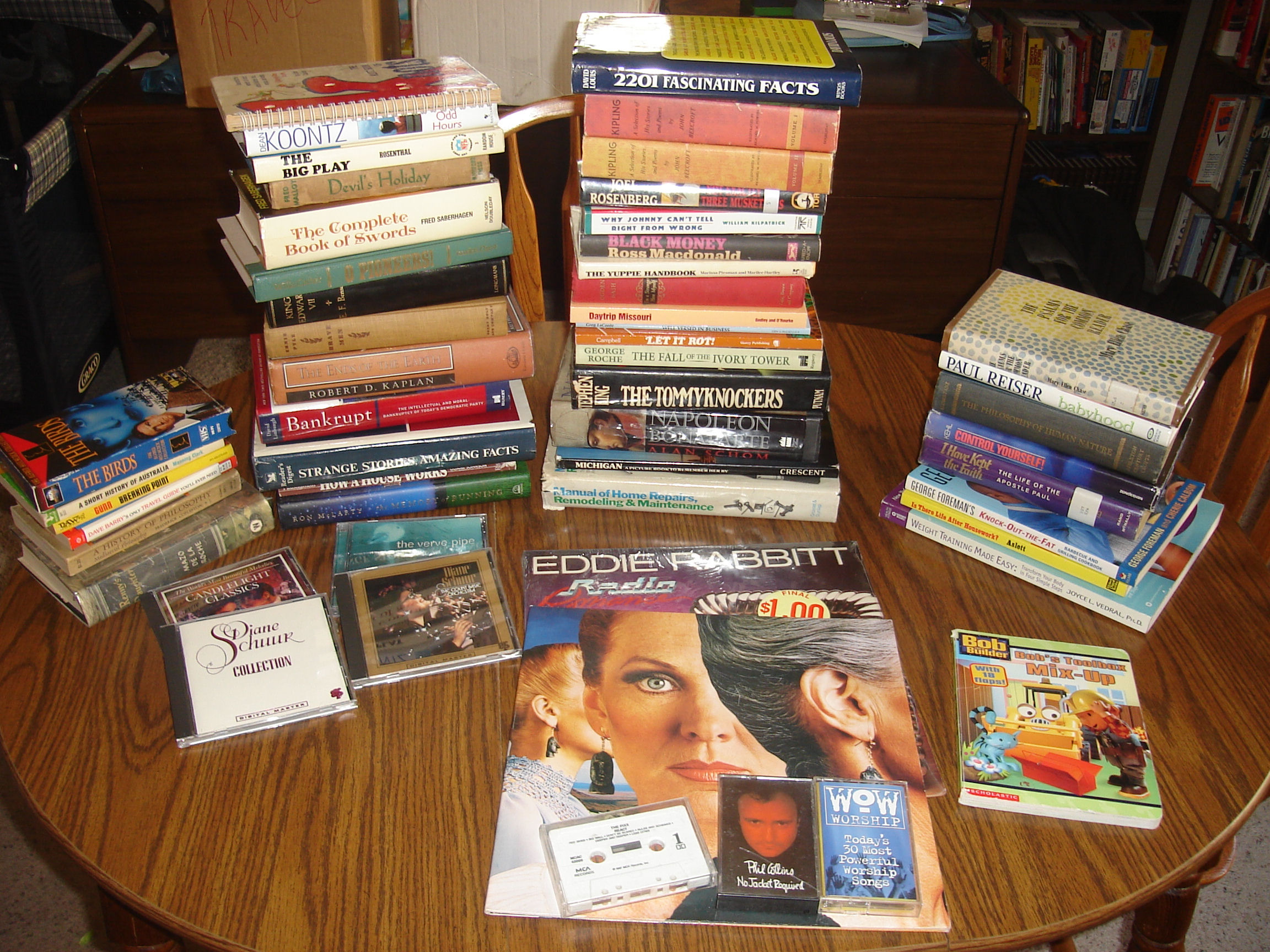
Click for full size
I got:
- The Birds on VHS. It was written by Evan Hunter, you know.
- A Short History of Australia because I don't have a lot of time for a long history of Australia. Speaking of which, since Pluto is a dwarf planet, shouldn't we also have a movement afoot to demote Australia to a dwarf continent?
- Breaking Point, a DAW paperback original science fiction thing. Just because.
- A volume in the History of Philosophy series. A duplicate, of course, but one of these days I'll get lucky. Or I'll get smart and list what I have so I don't buy up all the duplicates in circulation.
- Renny's Daughter, part of some series by Mazo de la Roche. I bought some others in the series. Why not get them all just in case I like them? Well, I guess the argument would be what if I don't like them, but I can always burn them for fuel.
- The Klutz's Guide to Knots, complete with strings to practice with. Should come in handy if I'm impressed onto a frigate.
- Odd Hours, by Dean Koontz. I already had a BOMC edition complete with erratum notice; this standard edition will replace it and provide my brother's new birthday gift.
- The Big Play, an old collection of big NFL plays.
- Devil's Holiday.
- The Complete Book of Swords. This had been in the history section, but I know better. The volunteers at St. Mattias appeared to be somewhat clueless since many books were classed according to the title and not the content.
- O Pioneers in the coveted Readers Digest edition no less.
- King Edward VII. A biography. Don't know who he is? Someday I won't be able to say that.
- Brave Men, a collection of works by Ernie Pyle.
- The Ends of the Earth by Robert Kaplan.
- Bankrupt: The Intellectual and Moral Bankruptcy of the Democratic Party. Get them before they're banned!
- Strange Stories, Amazing Facts, a Readers Digest collection. These are such good sources for ideas. I have so many, I should put the good ideas to use sometime.
- How a House Works, a home repair thing. I have so many, I should repair my house sometime.
- A Memory of Running by Ron McLarty. He played Sgt. Frank Belson on Spenser: For Hire, you know. I didn't need more reason than that.
- 2201 Amazing Facts, hopefully another idea source.
- 2 volumes of a collection of Kipling.
- Not Exactly the Three Musketeers, a Guardians of the Flame book by Joel Rosenberg. You know he's a CCL instructor, right?
- Why Johnny Can't Tell Right from Wrong, another screedish, no doubt, book.
- Black Money by Ross MacDonald. When you find a Ross MacDonald in the wild, you take it.
- The Yuppie Handbook. For times when I want to reminisce about being DINK and project myself into a city in the 1980s.
- I'm a Stranger Here Myself, poems by Ogden Nash. I shall have the whole set someday.
- Daytrip Missouri, a travel thing for Missouri.
- Well Versed in Business, poems about business.
- Let it Rot about composting.
- The Fall of the Ivory Tower, a screedish book a la The Hollow Men and ProfScam, I assume.
- The Tommyknockers by Stephen King.
- Napoleon Bonaparte. Man, if I ever start reading historical biographies, I will be set.
- Michigan, a picture book. Hopefully, it will skip Detroit (although I have looked at a picture book dedicated to that city in 2007).
- Manual of Home Repairs, Remodeling, and Maintenance. See comment above for the other home repair book.
I'm only going by line numbers here in my HTML editor, but is that 32 books? That puts me at 52 purchased for the month before the deluge.
The JCC Mini Sale
This year, apparently the Jewish Community Center in Creve Coeur will renovate the building that houses its book fair, so they threw a mini-book fair for five days in January. We were going to go on Tuesday, the penultimate day, but a schedule conflict emerged, so we ended up going on the last day. Five dollar bag day. You know what that means.
I didn't have too many books, but then I looked again at a large collection of Walter J. Black-printed three-mysteries-to-a-volume series, and thought, "Man, I could pick those all up for $10. So I did, and then some:
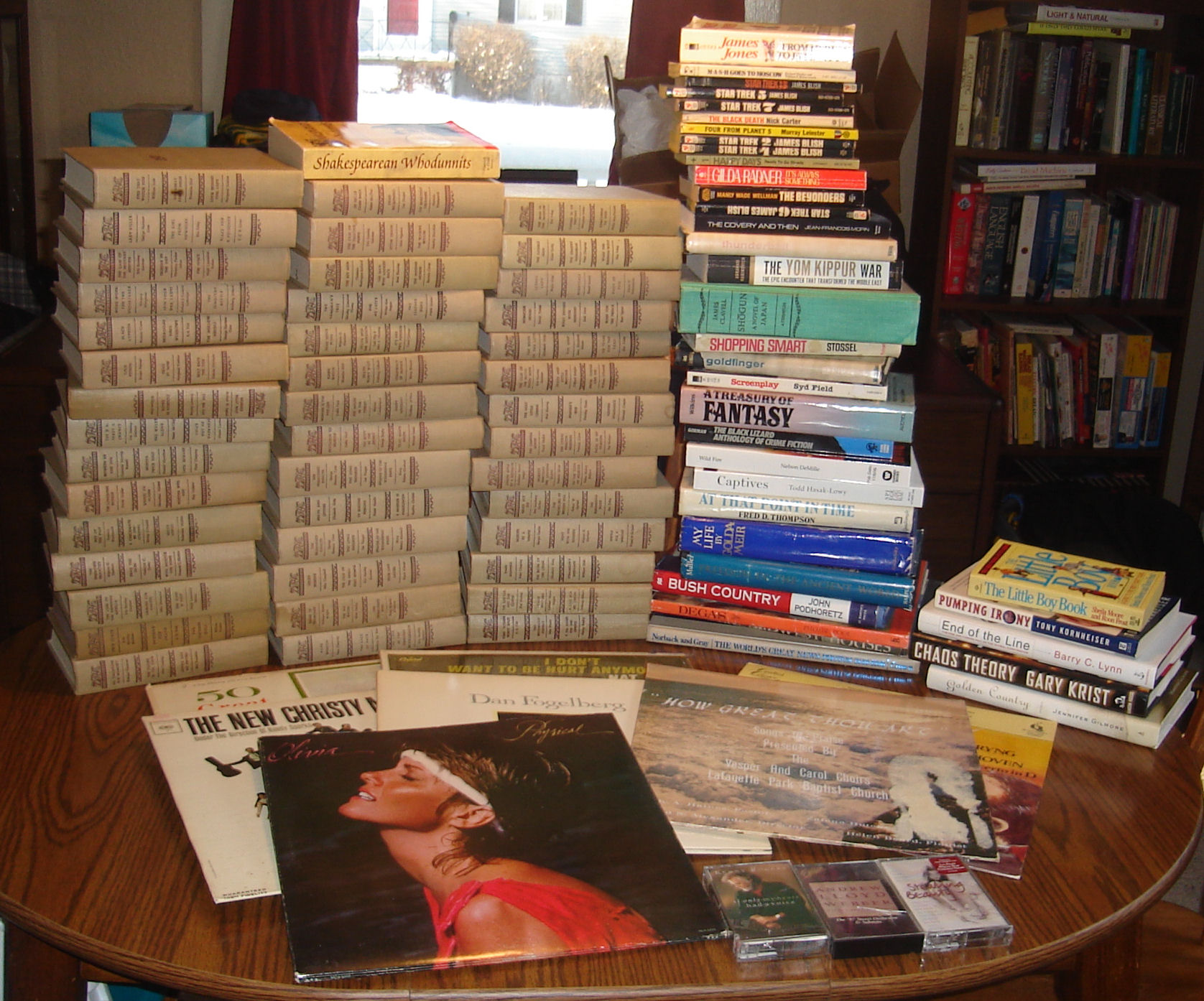
Click for full size
I got:
- 43 of the aforementioned mystery books, or 129 mystery novels total.
- Shakespeare Whodunnits, mysteries based on Shakespeare plays.
- From Here to Eternity by James Jones. I am on a WWII kick here. By "kick," I mean buying a lot of WWII books.
- M*A*S*H Goes to Moscow, a book based on the television series.
- Star Trek 2-7. Some are dupes, but they all fit in the bag, dig?
- The Black Death by Nick Carter. Quality pulp.
- Four From Planet 5, a science fiction thing about kids from another planet.
- Happy Days: Ready to Go Steady, a book based on the television series.
- It's Always Something, the autobiography of Gilda Radner.
- The Beyonders by Manly Wade Wellman. Probably not about the Secret Wars or Cosmic Cubes.
- The Covery and Then. I have no idea. I bought that?
- Thunderball, the James Bond novel.
- The Yom Kippur War, a historical account. The J is always good for Israeli history; what are the odds?
- Shogun. Remember the miniseries? I remember it was on. Sometime around the time Masada was on, too.
- Shopping Smart, an early book by John Stossel.
- Goldfinger, another Bond novel.
- Screenplay, a book about how to write screenplays? Hey, it fit in the bag.
- Wild Fun, a galley or ARC of a novel by Nelson DeMille. The J is also good for prepublication materials.
- Captives, a galley or ARC of another novel. Bought because it's prepublication and hence worth more if anyone bothers collecting books in 20 years and this chap is any good. If not, it burns at a cozy 451 degrees.
- At That Point In Time, Fred's book about Watergate.
- My Life by Golda Meir. I think I already have this in paperback, in which case the hardback is a replacement.
- Freedom in the Ancient World, a book that examines and, hopefully, rates the individual freedom in ancient societies.
- Bush Country, a pro-Bush screed.
- Degas, a picture book of the artist's work.
- Historic Midwest Houses, a picture book of, well, you can guess.
- The World's Great News Photographs 1840-1980
As you know, on dollar bag day (or $5 bag day in this case), you buy books by volume. Our collection was four bags, so $20. We didn't even really try to stuff the bags. The selection wasn't the best, as it was only a minibook fair and the last day of it to boot. Maybe I was a little gun shy about going nuts, too, knowing it was license to acquire too much. Because, you know, 73 books wasn't too much.
Total: 124 new books.
That is, more than a year's worth of reading bought in one month.
And it's not even book sale season yet.
- posted by Brian J. @ 1:07 PM 0 comments

Book Report: Master and Commander by Patrick O'Brian (1970)
After I read the first book in the Sharpe series, I realized that I didn't have the second book in that series, so I looked around for other historical fiction on my shelves, and I came to this book. I'd seen the movie Master and Commander: The Far Side of the World, but apparently that is a later book in the series. This book introduces Jack Aubrey and the surgeon characters and describes Aubrey's first command.
Meticulously researched, the book describes the technology, procedures, and military of the era as much as any Clancy novel. However, the pacing on this book is very mellow and languid. A lot of exposition, some action, more exposition, some politicking, some exposition, action, and the novel kind of ends without a real climax.
As such, it's not as compelling as Clancy or Cornwell, but still interesting enough that I wouldn't mind reading the next in the series.
Apparently, I'm really getting into British military history ca 1800 with the Sharpe and Aubrey/Maturin books. Reading these makes me want to do my own research so I can really be steeped in what the authors describe, so that the exposition isn't educational but merely a reminder. Maybe I should get into Civil War fiction instead since I already have a good library on it.
- posted by Brian J. @ 8:00 AM 0 comments
Friday, February 06, 2009
Book Report: St. Louis 365 by Joe Sonderman (2002)
First of all, let's log the defect. The book is called St. Louis 365, but it includes February 29, so it should be St. Louis 366.
That said, it take each day of the year and relates a set of things that happened on it in St. Louis history. Sonderman and his assistants scoured newspaper archives, apparently, to come up with this list. It includes a lot of one-off tidbits that give you neat little origins for street names and whatnot throughout the city and county, but also provide some narrative in identifying events in a series for larger stories, such as the Greenlease kidnapping and the World's Fair in 1904.
It took me a while to get through it, since it's not a book that drags you along. It is, however, a good book for stop and start, pick it up for a couple minutes in a doctor's waiting room, sort of reading. I started reading it last year when I was going through browseable books during ballgames and only finished it in January.
But a good idea book and something that will give me odd bits of trivia to throw out randomly in conversations where the trivia don't exactly fit and will meet a sort of stunned silence as people puzzle out the irrelevance. But that's why I read.
- posted by Brian J. @ 8:07 AM 0 comments
Well, If His Signatures Are On The Checks
AP helpfully kicks Bush again: Bush overpaid banks in bailout, watchdog says.
So, will Obama be at fault when the new stimulus plans, or will it be the dark nature of humanity rejecting or sinning against the perfection of Porktopia?
- posted by Brian J. @ 7:53 AM 2 comments
Thursday, February 05, 2009
Book Report: Godless by Ann Coulter (2006)
Any book with Ann Coulter on the cover, you kinda know what you're getting. Ann Coulter.
This book is a little schizophrenic, as it really has two parts. The first is normal liberals are bad men and women sort of thing you get on the Internet and in Coulter columns. Whereas she's amusing in columns and in short doses, sometimes a book-length treatise by Coulter grates on my nerves.
So I was fortunate, surprised, and pleased when the book took a thoughtful turn into exploring intelligent design versus evolution debate, exposing some of the holes in the evolution theory and keeping the mouth, or its textual equivalent, to a snarky minimum throughout.
I don't read the debates nor the supporting materials very closely, but Coulter's treatment was a decent survey of it. After a couple chapters of the normal political nyah nyah of which this blog often joins in.
- posted by Brian J. @ 7:20 AM 0 comments
Wednesday, February 04, 2009
Book Report: A Clear and Present Danger by Tom Clancy (1989)
When reading Clancy books, you come away from them about seven hundred pages later with the description, "It's the drug war in Colombia one," or "It's the nuke at the Superbowl one," or "It's the one with the submarine." This one happens to be the one with the drug war in Colombia. Maybe that's better than you get with a lot of thrillers, especially ones of this size.
The British first edition I have here clocks in at 816 pages; you know what? That's sort of okay, since Clancy is quite honestly writing serious epic stuff here. Even though this one doesn't bring the United States to the brink of a major war, it has enough tension within it to mostly sustain its size. Clancy uses his standard characters of Ryan and Clark (and introduces some soon-to-be standard ones in this book). Additionally, he details a lot of incidents and makes a lot of throwaway minor characters into actual characters.
Plot summary: The US government sends covert troops into Colombia to report on drug flights leaving; when the drug lords kill an important government official, the government orders them to start attacking. And then the government abandons them when it's convenient, but Jack Ryan and Clark don't let that happen.
There's a lot of double-dealing, a lot of plot turns, and it almost makes you forget you're reading 800 pages of fiction. But not quite.
Still, it moves along faster than a Dickens novel (but Dickens novels, being shorter, are quicker to the finish line). It's also quicker than an O'Brian Master and Commander sort of book, which carries the same amount of technology cut into it (albeit an old-fashioned technology). And a meal of Clancy really sates your thirst for his books for another year or two and opens a big space on your to-read bookshelves for stuff coming from book fairs this year.
If that's not a book report damning with faint praise, I don't know what it; however, I did enjoy it.
a
- posted by Brian J. @ 7:52 AM 0 comments
Tuesday, February 03, 2009
They're Going To Put Them On Stilts?
Most flooded homes will be raised
Them homophones are tricky. Not that there's anything wrong with that.
- posted by Brian J. @ 7:52 PM 0 comments
It Says Something About Us, And Not Something Necessarily Flattering
Today, I changed the paperclip in my sainted mother's toilet.
This time, I used a rubber-covered one, so it should last a while.
- posted by Brian J. @ 7:45 PM 0 comments
Book Report: Urban Affairs by Elaine Viets (1988)
Man, I lament that the St. Louis paper doesn't have a real metro/lifestyle columnist, what with Bill McClellan and his "Here's a bad guy who's in a bad situation, don't you feel bad for him" schtick and the black guy. But when it did, I didn't pay too much attention. Aw, heck, I was just a kid.
This book collects a hundred or so columns from Viets's tenure at the St. Louis Post-Dispatch, and she covers the South Side of the city with an eye for amusing anecdotes and St. Louisisms. As I've now spent more time in St. Louis than my home town, unfortunately, I enjoy these stories way too much.
So I should go forth and look for more of Viets's collections or try some of her fiction. I shall.
Aside, tying in books I've read. The cover shot for this book, unavailable from Amazon, was taken at the Coral Courts motel; the first couple of columns talk about its preservation attempt, and Viets wrote about it in the forward to the book Tales from the Coral Court, which I reported about in November 2007.
- posted by Brian J. @ 7:19 AM 0 comments
Monday, February 02, 2009
Book Report: Dead Watch by John Sandford (2006)
Oh, spare me. Is there any damn thriller writer operating after 2000 who doesn't feel compelled to take shots at Republicans and/or President Bush? Because Ed McBain did it, and Robert B. Parker does it, and with this book, Sandford gets his digs in. We've got the closeted gay rich former Senator and his circle of evil gay Republicans, we've got the clandestine meeting with an RNC official at the museum because nobody from his work goes there (maybe it would be better for the Republic if they did, haw haw!). Hey, did you know the RNC HQ was reinforced because a teacher tried to blow himself up at it to protest Republican educational policies (I don't blame him, says the first person narrator). Don't get me wrong, Sandford has his bad apples in the Democrat party, too, but they're bad apples, gun nuts, and thugs in the party; it's not the party itself nor its views that are a priori bad. Does Sandford think he can get away with it because he thinks that Republicans aren't literate enough to read books not written by Ann Coulter? Or does he think we should be thick-skinned enough to take a joke, even though we take that damned joke every day in the media, from the government, and throughout the Internet? I don't know, but jeez, I lost a lot of respect for Sandford.
That diatribe aside, this book distills most of the bad aspects of a Lucas Davenport number and transplants it to Washington, perhaps so Sandford can become a national thriller writer and not a regional author. There's a crime, or series thereof, but the book spends an awful lot of time worrying not about right or wrong or serving justice, but serving political ends. How will this play? How will that play? How should the hero do this to minimize political fallout? And so on. I can take some of that in a Davenport novel because they weren't always that way, and if I read them out of order, I can mix in the better novels with the lessers. But here, Sandford dangles it all out. A disabled Afghanistan vet now works as a fixer for the White House Chief of Staff and has to investigate the disappearance of the closeted gay rich Republican former Senator who might have a politically damaging "package"--evidence of corruption--that could hurt the reelection chances of the President. His first goal is to protect the Democrats in power, natch.
After a while and some more dead gay Republicans, the situation is resolved with the stock ambush-in-the-woods.
So, Sandford, how come all the veterans in the book are disabled Afghanistan vets except for, you know, the psychotic ones?
Ah, who knows. I'm glad this Sandford book is the last on my unread shelves for now. I think I'd be a better person, and at least in a better mood, if it were still up there.
Meanwhile, I think I'll confine myself to old crime fiction again, back before they were compelled to attack the political beliefs of roughly half of the country.
Or Robert Crais, who hasn't done this sort of thing so far. I hope I didn't just out somebody.
- posted by Brian J. @ 7:25 AM 0 comments
Superbowl Recap
So the team I'm rooting for goes down big on a mistake or turnover, then fights its way back to take a small lead with very little time left, when suddenly the defense collapses and the opponents march down the field to score the winning touchdown, followed by my team turning the ball over in its last second desperation drive?
It felt like I was watching a Packers game.
- posted by Brian J. @ 7:09 AM 4 comments
Sunday, February 01, 2009
Book Report: Sharpe's Tiger by Bernard Cornwell (1997)
I got this book at a garage sale last April, along with 10 others in the 20-something volume series. You know what? Ultimately, I made a mistake. The eleven I have are not contiguous in the series, and after this dose, I want to read the series in order. So instead of a cheap set of books, this one might prove to be pretty expensive if I have to fill in the books at full price.
This book details Private Sharpe's participation at the seige of Seringapatam in 1799. Not just a grunt's level view of life in her majesty's army, but a good look at that nevertheless with detailed but readable. Sharpe gets under the skin of a sargeant and is drawn into striking the man, which warrants a flogging whose number is not only gratuitious, but also a death sentence in the tropics. He is reprieved and sent into the enemy stronghold as a deserter. His real mission: find a senior intelligence official held captive and get his information and, if possible, him out.
An excellent set of books, if this is any predictor.
- posted by Brian J. @ 7:44 AM 0 comments
To say Noggle, one first must be able to say the "Nah."
"I will."
Heather L. Igert,
angelweave.mu.nu
"Genuis."
Neil Steinberg,
Chicago Sun-Times
"Some wanker."
Kim du Toit,
on the Noggle Library.
"Brian J. Noggle apparently forgot that the proper design for a tin foil beanie calls for the shiny side out."
Robb Allen,
Sharp as a Marble.
"I'm weeping openly right now. Thanks for hurting my feelings, pinhead."
Bob Rybarcyzk,
St. Louis Post-Dispatch
Instapundit
Protein Wisdom
Ace of Spades HQ
Wizbang!
Outside the Beltway
Robert B. Parker
Dustbury
Damn Interesting
Michelle Malkin
Radley Balko's The Agitator
Exultate Justi
The McGehee Zone
Signifying Nothing
The Jawa Report
Master of None
Dr. Helen
The Anchoress
Electric Venom
Kim Du Toit
Belmont Club
Little Green Footballs
Overtaken by Events
Rocket Jones
Boots and Sabers
Triticale
Ann Althouse
The American Mind
Ravenwood's Universe
Asymmetrical Information
Boondoggled
VodkaPundit
Professor Bainbridge
Virginia Postrel
Ken Jennings
Joanne Jacobs
Faster Than The World
Dilbert Blog
Junkyard Blog
In DC Journal
IMAO
Baldilocks
Powerline
Q and O
Hugh Hewitt
Buzz Machine
Daniel Drezner
Roger Simon
American Digest
Blackfive
The Volokh Conspiracy
Cold Fury
Captain's Quarters
Tim Blair
Chequer-Board
Emperor Misha
Just One Minute
Blame Bush
Inaniloquent
Trey Givens
OverLawyered
Suburban Blight
Another Rovian Conspiracy
Angelweave
Bad Example
Rachel Lucas
View from the Porch
StL Recruiting
a big victory
Spector's Hockey
Fark
/.
TechDirt
F*****d Company
CNet News
Joel on Software
James Lileks Mark Steyn Bob Rybarczyk
Richard Roeper
Neil Steinberg
John Kass
Steven Chapman
Drudge Report Ananova Slate Reason's Hit and Run
Best of the Web Today
National Review's The Corner
Tech Central Station
Fox News
CNN
Washington Post
Washington Times
Chicago Tribune
Chicago Sun-Times Milwaukee Journal-Sentinel
St. Louis Post-Dispatch
San Francisco Chronicle
New York Post
Shepherd Express
Riverfront Times
New York Observer
ScrappleFace Bob from Accounting The Onion Top Five List David Letterman's Top Ten BBSpot
U.S. Constitution
Declaration of Independence
Snopes.Com (Urban Legends)
Dictionary.com
Internet Movie Database
Complete Works of Shakespeare
Marvel Directory
Blooberry HTML Reference

Our helpful staff is ready to serve you!

Visualize World Hegemony

Cog in the Machine

Tao Sharks

Humor not displayed

Beware of Conservative
3/30/03 - 4/6/03
4/6/03 - 4/13/03
4/13/03 - 4/20/03
4/20/03 - 4/27/03
4/27/03 - 5/4/03
5/4/03 - 5/11/03
5/11/03 - 5/18/03
5/18/03 - 5/25/03
5/25/03 - 6/1/03
6/1/03 - 6/8/03
6/8/03 - 6/15/03
6/15/03 - 6/22/03
6/22/03 - 6/29/03
6/29/03 - 7/6/03
7/6/03 - 7/13/03
7/13/03 - 7/20/03
7/20/03 - 7/27/03
7/27/03 - 8/3/03
8/3/03 - 8/10/03
8/10/03 - 8/17/03
8/17/03 - 8/24/03
8/24/03 - 8/31/03
8/31/03 - 9/7/03
9/7/03 - 9/14/03
9/14/03 - 9/21/03
9/21/03 - 9/28/03
9/28/03 - 10/5/03
10/5/03 - 10/12/03
10/12/03 - 10/19/03
10/19/03 - 10/26/03
10/26/03 - 11/2/03
11/2/03 - 11/9/03
11/9/03 - 11/16/03
11/16/03 - 11/23/03
11/23/03 - 11/30/03
11/30/03 - 12/7/03
12/7/03 - 12/14/03
12/14/03 - 12/21/03
12/21/03 - 12/28/03
12/28/03 - 1/4/04
1/4/04 - 1/11/04
1/11/04 - 1/18/04
1/18/04 - 1/25/04
1/25/04 - 2/1/04
2/1/04 - 2/8/04
2/8/04 - 2/15/04
2/15/04 - 2/22/04
2/22/04 - 2/29/04
2/29/04 - 3/7/04
3/7/04 - 3/14/04
3/14/04 - 3/21/04
3/21/04 - 3/28/04
3/28/04 - 4/4/04
4/4/04 - 4/11/04
4/11/04 - 4/18/04
4/18/04 - 4/25/04
4/25/04 - 5/2/04
5/2/04 - 5/9/04
5/9/04 - 5/16/04
5/16/04 - 5/23/04
5/23/04 - 5/30/04
5/30/04 - 6/6/04
6/6/04 - 6/13/04
6/13/04 - 6/20/04
6/20/04 - 6/27/04
6/27/04 - 7/4/04
7/4/04 - 7/11/04
7/11/04 - 7/18/04
7/18/04 - 7/25/04
7/25/04 - 8/1/04
8/1/04 - 8/8/04
8/8/04 - 8/15/04
8/15/04 - 8/22/04
8/22/04 - 8/29/04
8/29/04 - 9/5/04
9/5/04 - 9/12/04
9/12/04 - 9/19/04
9/19/04 - 9/26/04
9/26/04 - 10/3/04
10/3/04 - 10/10/04
10/10/04 - 10/17/04
10/17/04 - 10/24/04
10/24/04 - 10/31/04
10/31/04 - 11/7/04
11/7/04 - 11/14/04
11/14/04 - 11/21/04
11/21/04 - 11/28/04
11/28/04 - 12/5/04
12/5/04 - 12/12/04
12/12/04 - 12/19/04
12/19/04 - 12/26/04
12/26/04 - 1/2/05
1/2/05 - 1/9/05
1/9/05 - 1/16/05
1/16/05 - 1/23/05
1/23/05 - 1/30/05
1/30/05 - 2/6/05
2/6/05 - 2/13/05
2/13/05 - 2/20/05
2/20/05 - 2/27/05
2/27/05 - 3/6/05
3/6/05 - 3/13/05
3/13/05 - 3/20/05
3/20/05 - 3/27/05
3/27/05 - 4/3/05
4/3/05 - 4/10/05
4/10/05 - 4/17/05
4/17/05 - 4/24/05
4/24/05 - 5/1/05
5/1/05 - 5/8/05
5/8/05 - 5/15/05
5/15/05 - 5/22/05
5/22/05 - 5/29/05
5/29/05 - 6/5/05
6/5/05 - 6/12/05
6/12/05 - 6/19/05
6/19/05 - 6/26/05
6/26/05 - 7/3/05
7/3/05 - 7/10/05
7/10/05 - 7/17/05
7/17/05 - 7/24/05
7/24/05 - 7/31/05
7/31/05 - 8/7/05
8/7/05 - 8/14/05
8/14/05 - 8/21/05
8/21/05 - 8/28/05
8/28/05 - 9/4/05
9/4/05 - 9/11/05
9/11/05 - 9/18/05
9/18/05 - 9/25/05
9/25/05 - 10/2/05
10/2/05 - 10/9/05
10/9/05 - 10/16/05
10/16/05 - 10/23/05
10/23/05 - 10/30/05
10/30/05 - 11/6/05
11/6/05 - 11/13/05
11/13/05 - 11/20/05
11/20/05 - 11/27/05
11/27/05 - 12/4/05
12/4/05 - 12/11/05
12/11/05 - 12/18/05
12/18/05 - 12/25/05
12/25/05 - 1/1/06
1/1/06 - 1/8/06
1/8/06 - 1/15/06
1/15/06 - 1/22/06
1/22/06 - 1/29/06
1/29/06 - 2/5/06
2/5/06 - 2/12/06
2/12/06 - 2/19/06
2/19/06 - 2/26/06
2/26/06 - 3/5/06
3/5/06 - 3/12/06
3/12/06 - 3/19/06
3/19/06 - 3/26/06
3/26/06 - 4/2/06
4/9/06 - 4/16/06
4/16/06 - 4/23/06
4/23/06 - 4/30/06
4/30/06 - 5/7/06
5/7/06 - 5/14/06
5/14/06 - 5/21/06
5/21/06 - 5/28/06
5/28/06 - 6/4/06
6/4/06 - 6/11/06
6/11/06 - 6/18/06
6/18/06 - 6/25/06
6/25/06 - 7/2/06
7/2/06 - 7/9/06
7/9/06 - 7/16/06
7/16/06 - 7/23/06
7/23/06 - 7/30/06
7/30/06 - 8/6/06
8/6/06 - 8/13/06
8/13/06 - 8/20/06
8/20/06 - 8/27/06
8/27/06 - 9/3/06
9/3/06 - 9/10/06
9/10/06 - 9/17/06
9/17/06 - 9/24/06
9/24/06 - 10/1/06
10/1/06 - 10/8/06
10/8/06 - 10/15/06
10/15/06 - 10/22/06
10/22/06 - 10/29/06
10/29/06 - 11/5/06
11/5/06 - 11/12/06
11/12/06 - 11/19/06
11/19/06 - 11/26/06
11/26/06 - 12/3/06
12/3/06 - 12/10/06
12/10/06 - 12/17/06
12/17/06 - 12/24/06
12/24/06 - 12/31/06
12/31/06 - 1/7/07
1/7/07 - 1/14/07
1/14/07 - 1/21/07
1/21/07 - 1/28/07
1/28/07 - 2/4/07
2/4/07 - 2/11/07
2/11/07 - 2/18/07
2/18/07 - 2/25/07
2/25/07 - 3/4/07
3/4/07 - 3/11/07
3/11/07 - 3/18/07
3/18/07 - 3/25/07
3/25/07 - 4/1/07
4/1/07 - 4/8/07
4/8/07 - 4/15/07
4/15/07 - 4/22/07
4/22/07 - 4/29/07
4/29/07 - 5/6/07
5/6/07 - 5/13/07
5/13/07 - 5/20/07
5/20/07 - 5/27/07
5/27/07 - 6/3/07
6/3/07 - 6/10/07
6/10/07 - 6/17/07
6/17/07 - 6/24/07
6/24/07 - 7/1/07
7/1/07 - 7/8/07
7/8/07 - 7/15/07
7/15/07 - 7/22/07
7/22/07 - 7/29/07
7/29/07 - 8/5/07
8/5/07 - 8/12/07
8/12/07 - 8/19/07
8/19/07 - 8/26/07
8/26/07 - 9/2/07
9/2/07 - 9/9/07
9/9/07 - 9/16/07
9/16/07 - 9/23/07
9/23/07 - 9/30/07
9/30/07 - 10/7/07
10/7/07 - 10/14/07
10/14/07 - 10/21/07
10/21/07 - 10/28/07
10/28/07 - 11/4/07
11/4/07 - 11/11/07
11/11/07 - 11/18/07
11/18/07 - 11/25/07
11/25/07 - 12/2/07
12/2/07 - 12/9/07
12/9/07 - 12/16/07
12/16/07 - 12/23/07
12/23/07 - 12/30/07
12/30/07 - 1/6/08
1/6/08 - 1/13/08
1/13/08 - 1/20/08
1/20/08 - 1/27/08
1/27/08 - 2/3/08
2/3/08 - 2/10/08
2/10/08 - 2/17/08
2/17/08 - 2/24/08
2/24/08 - 3/2/08
3/2/08 - 3/9/08
3/9/08 - 3/16/08
3/16/08 - 3/23/08
3/23/08 - 3/30/08
3/30/08 - 4/6/08
4/6/08 - 4/13/08
4/13/08 - 4/20/08
4/20/08 - 4/27/08
4/27/08 - 5/4/08
5/4/08 - 5/11/08
5/11/08 - 5/18/08
5/18/08 - 5/25/08
5/25/08 - 6/1/08
6/1/08 - 6/8/08
6/8/08 - 6/15/08
6/15/08 - 6/22/08
6/22/08 - 6/29/08
6/29/08 - 7/6/08
7/6/08 - 7/13/08
7/13/08 - 7/20/08
7/20/08 - 7/27/08
7/27/08 - 8/3/08
8/3/08 - 8/10/08
8/10/08 - 8/17/08
8/17/08 - 8/24/08
8/24/08 - 8/31/08
8/31/08 - 9/7/08
9/7/08 - 9/14/08
9/14/08 - 9/21/08
9/21/08 - 9/28/08
9/28/08 - 10/5/08
10/5/08 - 10/12/08
10/12/08 - 10/19/08
10/19/08 - 10/26/08
10/26/08 - 11/2/08
11/2/08 - 11/9/08
11/9/08 - 11/16/08
11/16/08 - 11/23/08
11/23/08 - 11/30/08
11/30/08 - 12/7/08
12/7/08 - 12/14/08
12/14/08 - 12/21/08
12/21/08 - 12/28/08
1/25/09 - 2/1/09
2/1/09 - 2/8/09
2/8/09 - 2/15/09
2/15/09 - 2/22/09
2/22/09 - 3/1/09
3/1/09 - 3/8/09
3/8/09 - 3/15/09
3/15/09 - 3/22/09
3/22/09 - 3/29/09
3/29/09 - 4/5/09
4/5/09 - 4/12/09
4/12/09 - 4/19/09
4/19/09 - 4/26/09
4/26/09 - 5/3/09
5/3/09 - 5/10/09
5/10/09 - 5/17/09
5/17/09 - 5/24/09
5/24/09 - 5/31/09
5/31/09 - 6/7/09
6/7/09 - 6/14/09
6/14/09 - 6/21/09
6/21/09 - 6/28/09
6/28/09 - 7/5/09
7/5/09 - 7/12/09
7/12/09 - 7/19/09
7/19/09 - 7/26/09
7/26/09 - 8/2/09
8/2/09 - 8/9/09
8/9/09 - 8/16/09
8/16/09 - 8/23/09
8/23/09 - 8/30/09
8/30/09 - 9/6/09
9/6/09 - 9/13/09
9/13/09 - 9/20/09
9/20/09 - 9/27/09
9/27/09 - 10/4/09
10/4/09 - 10/11/09
10/11/09 - 10/18/09
10/18/09 - 10/25/09
10/25/09 - 11/1/09
11/1/09 - 11/8/09
11/8/09 - 11/15/09
11/15/09 - 11/22/09
11/22/09 - 11/29/09
11/29/09 - 12/6/09
12/6/09 - 12/13/09
12/13/09 - 12/20/09
12/20/09 - 12/27/09
12/27/09 - 1/3/10
1/3/10 - 1/10/10
