Musings from Brian J. Noggle
Sunday, December 06, 2009
You Will Keep Doing It Until You Do It Right
Another electoral defeat for a tax increase just leads to a sequel, as the Christian County Library Board reanimates the undead and tries to get it on the next ballot:
- The Christian County Library Board is expected to decide this month whether to send a proposed property tax increase back to voters.
If approved, it would help build three libraries.
Library Director Mabel Phillips said the board met Nov. 20 to discuss the possibility of putting the issue on the April ballot.
It was the board's first meeting since 52 percent of voters rejected a proposed property tax increase during the Nov. 3 election.
- posted by Brian J. @ 9:30 AM 0 comments

Saturday, December 05, 2009
Book Report: Dead Low Tide by John D. MacDonald (1953)
This John D. MacDonald paperback original, written over 50 years ago, centers on a man working for a construction company whose boss commits suicide with a harpoon gun. The protagonist's harpoon gun. And it doesn't look like suicide after all. Circumstances and the individual plots of the individual people have hemmed him in as the suspect, though. But when the woman friend who the protagonist discovers too late he loves is found in a canal, the police have to turn him loose. For vengeance.
I hoped for a bit of bloodshed at the end, but there's no burst of gun violence. It wouldn't suit the characters, of course. MacDonald created another interesting little town with its own people, problems, and story. I like MacDonald. A lot. I was recently saddened to realize I will eventually have read all of his books.
- posted by Brian J. @ 8:49 AM 0 comments
Friday, December 04, 2009
Book Report: Homegoing by Frederik Pohl (1989)
I'm reviewing these books out of order; I read this book when I went through a recent sci-fi set including Solaris and Lovelock. So apparently it was not only a sci-fi set, but also a single word title sci-fi set.
This book centers on the return of a human rescued in space by the Haklh'hi. The young man was raised from infancy by the herd-like aliens. As they return him, they behave a little suspiciously, sending him into a civilization that has slipped after global warming and nuclear wars to determine how warlike the survivors remain. Unfortunately, the aliens have only prepared the boy by showing him old television shows, so the reconnaissance fails. And the Haklh'hi plans are not as benign as they've let on.
An interesting read, something to keep you puzzling what the final twist will be. At which time, you will say, "But of course."
- posted by Brian J. @ 7:40 AM 0 comments
Thursday, December 03, 2009
Book Report: Wildtrack by Bernard Cornwell (1988)
This is a very early thriller from a very young (from the book jacket photo) Cornwell. Probably precedes his success with historical novels, but this very book could be a historical novel of sorts since it deals with a veteran of the Falkland Islands War.
A disabled veteran, winner of the Victoria Cross, finds that his boat--the one thing he missed most--has been beached during his absence and stripped of gear. The probably culprit: a roughneck employed by the television personality who purchased the veteran's father's home. The guy is drawn into the television man's circle when the television man wants to produce a documentary about the veteran's heroism. The whole thing turns complicated when agents of the television man's former father-in-law look for revenge against the television guy for the accidental death of his wife in a yacht race. The television guy is going to race again and eventually the veteran gets involved.
It's a convoluted plot with a meandering pace. The book includes a lot of nautical detail, which sort of gummed it up since I was not that interested in it much. Perhaps the historical novels have similar pacing issues except that I'm interested in the details.
It's clear to see why Cornwell ended up in the genre where he did. Historical novels suit him better than straight ahead thrillers.
- posted by Brian J. @ 7:29 AM 0 comments
Wednesday, December 02, 2009
Talk About Instant Savings
I received two Forbes subscription renewals in the mail the other day. The same day. With a $40 difference in a six month subscription rate.
First, a congratulations on my recent move and an offer to renew at $59.95 for 26 issues:
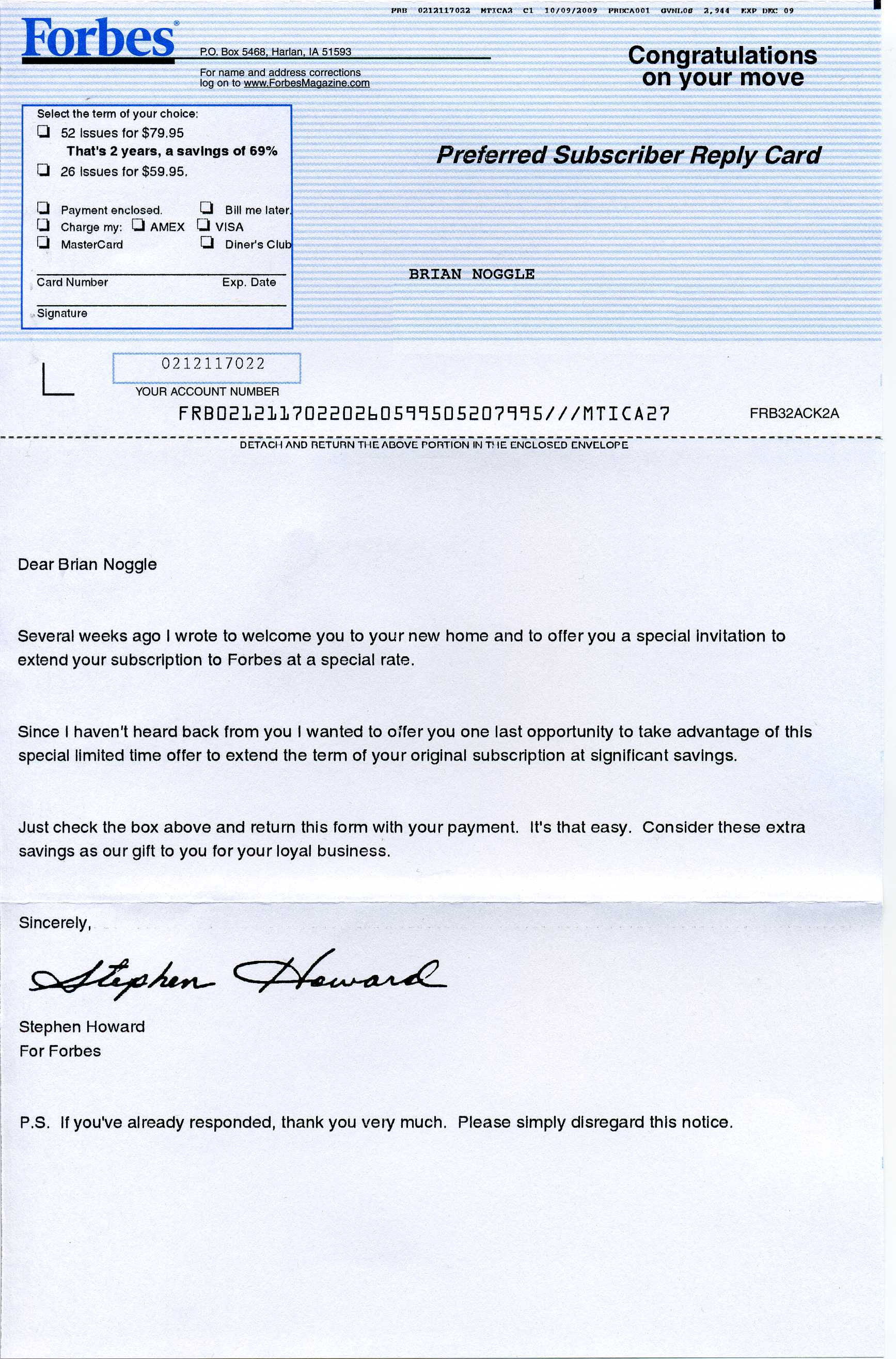
Click for full size
In another envelope, an offer to renew at $19.95 for 26 issues:
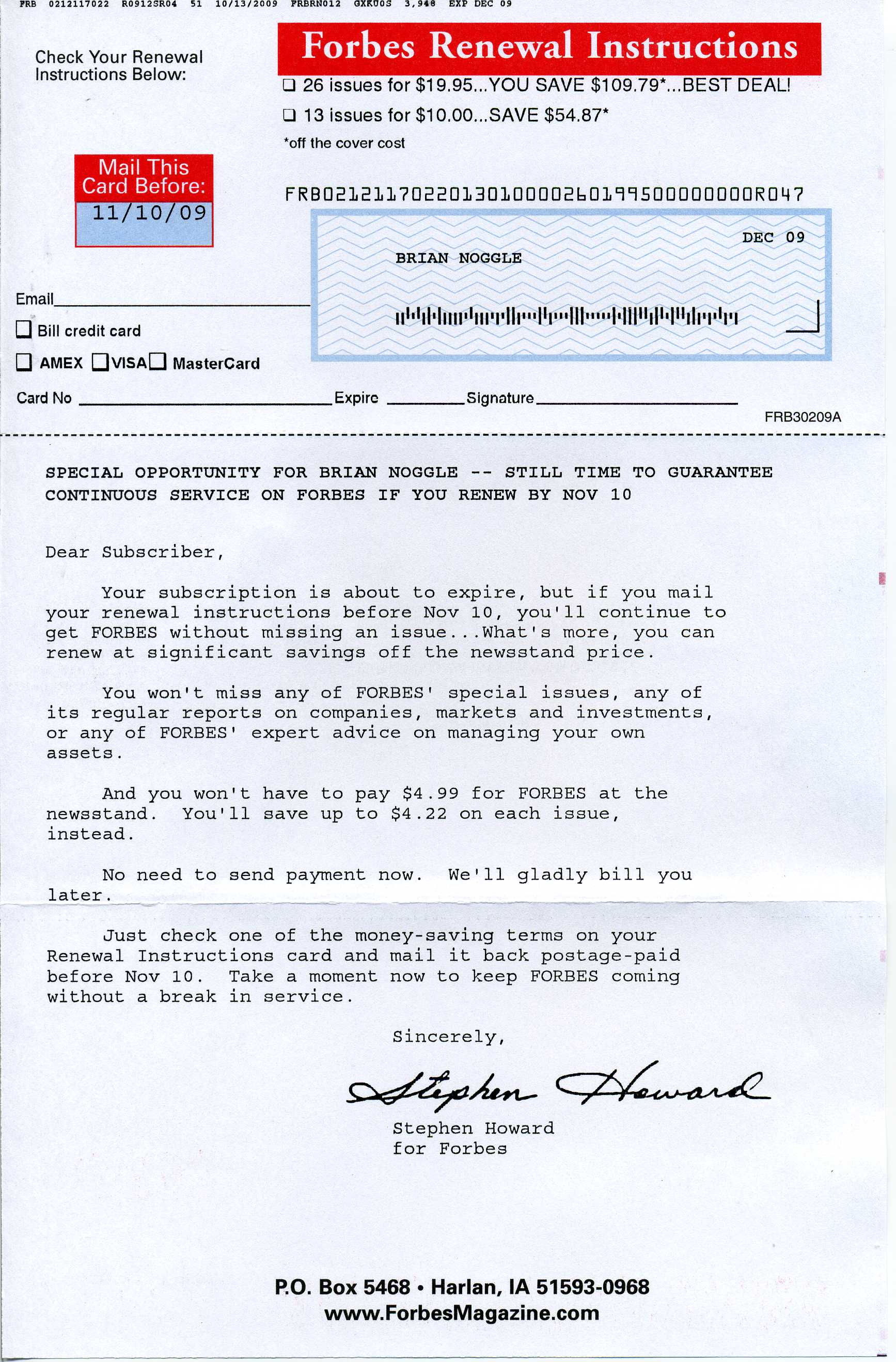
Click for full size
As you know, I take a larger number of magazines than I can read in a contemporary fashion. And you know one of the factors that makes me decide which ones to let expire?
How stupidly the circulation department treats you.
Forbes doesn't rival Fortune and other Time-Warner magazines in trying to trick you. Yet.
- posted by Brian J. @ 2:43 PM 0 comments
Tuesday, December 01, 2009
Book Report: Millennium by John Varley (1983)
As an anonymous commentor said when I reviewed Ben Bova's book of the same name, the novel Millennium by John Varley, based on the short story "Air Raid" by the same, is better than the film Millennium, based on the short story "Air Raid" by John Varley. You know, he's right, but it's a strange odyssey from the short story to each. According to Wikipedia:
- We had the first meeting on Millennium in 1979. I ended up writing it six times. There were four different directors, and each time a new director came in I went over the whole thing with him and rewrote it. Each new director had his own ideas, and sometimes you'd gain something from that, but each time something's always lost in the process, so that by the time it went in front of the cameras, a lot of the vision was lost.
An air crash investigator finds some anomalies with the crash. A time traveller from the future leads a team to recover people scheduled to die in air crashes and replace them with semi-living bodies to repopulate the species or something. Their goals intersect and create a paradox. The book interweaves their point of view, whereas the movie retreads the timeline a bit to turn the story from the investigator's tale to the woman's testimony.
The book has more depth and detail, as indicated, with the futurists from further in the future and not knowing the source even of the time traveling apparatus that lets them go back. Additionally, the characters are fleshed out, the robot is not a poor C3P0 clone, and there are real questions of free will and manipulation of time. Plus, the woman is harder and more crazy. However, it ends with in a fashion similar to Arthur C. Clarke's Rama series, where the Deus ex Machina is not a Machina at all.
An enjoyable read, and it made me watch the film again. You know, I haven't told you how I came to view the film. In 1996 or so, I had a membership at Blockbuster and was wont to go rent a film or two to pass an idle evening (before I got addicted to reading as heavily as I do now). So I was browsing, and I thought the film's box and teaser were interesting enough to warrant watching. I was disappointed with the film. Then, in 2007 or so, I was browsing Euclid Records in Webster Groves and found the DVD, and I thought, "Hmm, that looks interesting." It was only when I started watching it that I realized I'd seen it a decade earlier. Now, with the viewing after reading the book, I'm up to 3. That's probably more times than Cheryl Ladd and Kris Kristopherson have seen it combined.
Sick, I know.
- posted by Brian J. @ 8:48 AM 0 comments
To say Noggle, one first must be able to say the "Nah."
"I will."
Heather L. Igert,
angelweave.mu.nu
"Genuis."
Neil Steinberg,
Chicago Sun-Times
"Some wanker."
Kim du Toit,
on the Noggle Library.
"Brian J. Noggle apparently forgot that the proper design for a tin foil beanie calls for the shiny side out."
Robb Allen,
Sharp as a Marble.
"I'm weeping openly right now. Thanks for hurting my feelings, pinhead."
Bob Rybarcyzk,
St. Louis Post-Dispatch
Instapundit
Protein Wisdom
Ace of Spades HQ
Wizbang!
Outside the Beltway
Robert B. Parker
Dustbury
Damn Interesting
Michelle Malkin
Radley Balko's The Agitator
Exultate Justi
The McGehee Zone
Signifying Nothing
The Jawa Report
Master of None
Dr. Helen
The Anchoress
Electric Venom
Kim Du Toit
Belmont Club
Little Green Footballs
Overtaken by Events
Rocket Jones
Boots and Sabers
Triticale
Ann Althouse
The American Mind
Ravenwood's Universe
Asymmetrical Information
Boondoggled
VodkaPundit
Professor Bainbridge
Virginia Postrel
Ken Jennings
Joanne Jacobs
Faster Than The World
Dilbert Blog
Junkyard Blog
In DC Journal
IMAO
Baldilocks
Powerline
Q and O
Hugh Hewitt
Buzz Machine
Daniel Drezner
Roger Simon
American Digest
Blackfive
The Volokh Conspiracy
Cold Fury
Captain's Quarters
Tim Blair
Chequer-Board
Emperor Misha
Just One Minute
Blame Bush
Inaniloquent
Trey Givens
OverLawyered
Suburban Blight
Another Rovian Conspiracy
Angelweave
Bad Example
Rachel Lucas
View from the Porch
StL Recruiting
a big victory
Spector's Hockey
Fark
/.
TechDirt
F*****d Company
CNet News
Joel on Software
James Lileks Mark Steyn Bob Rybarczyk
Richard Roeper
Neil Steinberg
John Kass
Steven Chapman
Drudge Report Ananova Slate Reason's Hit and Run
Best of the Web Today
National Review's The Corner
Tech Central Station
Fox News
CNN
Washington Post
Washington Times
Chicago Tribune
Chicago Sun-Times Milwaukee Journal-Sentinel
St. Louis Post-Dispatch
San Francisco Chronicle
New York Post
Shepherd Express
Riverfront Times
New York Observer
ScrappleFace Bob from Accounting The Onion Top Five List David Letterman's Top Ten BBSpot
U.S. Constitution
Declaration of Independence
Snopes.Com (Urban Legends)
Dictionary.com
Internet Movie Database
Complete Works of Shakespeare
Marvel Directory
Blooberry HTML Reference

Our helpful staff is ready to serve you!

Visualize World Hegemony

Cog in the Machine

Tao Sharks

Humor not displayed

Beware of Conservative
3/30/03 - 4/6/03
4/6/03 - 4/13/03
4/13/03 - 4/20/03
4/20/03 - 4/27/03
4/27/03 - 5/4/03
5/4/03 - 5/11/03
5/11/03 - 5/18/03
5/18/03 - 5/25/03
5/25/03 - 6/1/03
6/1/03 - 6/8/03
6/8/03 - 6/15/03
6/15/03 - 6/22/03
6/22/03 - 6/29/03
6/29/03 - 7/6/03
7/6/03 - 7/13/03
7/13/03 - 7/20/03
7/20/03 - 7/27/03
7/27/03 - 8/3/03
8/3/03 - 8/10/03
8/10/03 - 8/17/03
8/17/03 - 8/24/03
8/24/03 - 8/31/03
8/31/03 - 9/7/03
9/7/03 - 9/14/03
9/14/03 - 9/21/03
9/21/03 - 9/28/03
9/28/03 - 10/5/03
10/5/03 - 10/12/03
10/12/03 - 10/19/03
10/19/03 - 10/26/03
10/26/03 - 11/2/03
11/2/03 - 11/9/03
11/9/03 - 11/16/03
11/16/03 - 11/23/03
11/23/03 - 11/30/03
11/30/03 - 12/7/03
12/7/03 - 12/14/03
12/14/03 - 12/21/03
12/21/03 - 12/28/03
12/28/03 - 1/4/04
1/4/04 - 1/11/04
1/11/04 - 1/18/04
1/18/04 - 1/25/04
1/25/04 - 2/1/04
2/1/04 - 2/8/04
2/8/04 - 2/15/04
2/15/04 - 2/22/04
2/22/04 - 2/29/04
2/29/04 - 3/7/04
3/7/04 - 3/14/04
3/14/04 - 3/21/04
3/21/04 - 3/28/04
3/28/04 - 4/4/04
4/4/04 - 4/11/04
4/11/04 - 4/18/04
4/18/04 - 4/25/04
4/25/04 - 5/2/04
5/2/04 - 5/9/04
5/9/04 - 5/16/04
5/16/04 - 5/23/04
5/23/04 - 5/30/04
5/30/04 - 6/6/04
6/6/04 - 6/13/04
6/13/04 - 6/20/04
6/20/04 - 6/27/04
6/27/04 - 7/4/04
7/4/04 - 7/11/04
7/11/04 - 7/18/04
7/18/04 - 7/25/04
7/25/04 - 8/1/04
8/1/04 - 8/8/04
8/8/04 - 8/15/04
8/15/04 - 8/22/04
8/22/04 - 8/29/04
8/29/04 - 9/5/04
9/5/04 - 9/12/04
9/12/04 - 9/19/04
9/19/04 - 9/26/04
9/26/04 - 10/3/04
10/3/04 - 10/10/04
10/10/04 - 10/17/04
10/17/04 - 10/24/04
10/24/04 - 10/31/04
10/31/04 - 11/7/04
11/7/04 - 11/14/04
11/14/04 - 11/21/04
11/21/04 - 11/28/04
11/28/04 - 12/5/04
12/5/04 - 12/12/04
12/12/04 - 12/19/04
12/19/04 - 12/26/04
12/26/04 - 1/2/05
1/2/05 - 1/9/05
1/9/05 - 1/16/05
1/16/05 - 1/23/05
1/23/05 - 1/30/05
1/30/05 - 2/6/05
2/6/05 - 2/13/05
2/13/05 - 2/20/05
2/20/05 - 2/27/05
2/27/05 - 3/6/05
3/6/05 - 3/13/05
3/13/05 - 3/20/05
3/20/05 - 3/27/05
3/27/05 - 4/3/05
4/3/05 - 4/10/05
4/10/05 - 4/17/05
4/17/05 - 4/24/05
4/24/05 - 5/1/05
5/1/05 - 5/8/05
5/8/05 - 5/15/05
5/15/05 - 5/22/05
5/22/05 - 5/29/05
5/29/05 - 6/5/05
6/5/05 - 6/12/05
6/12/05 - 6/19/05
6/19/05 - 6/26/05
6/26/05 - 7/3/05
7/3/05 - 7/10/05
7/10/05 - 7/17/05
7/17/05 - 7/24/05
7/24/05 - 7/31/05
7/31/05 - 8/7/05
8/7/05 - 8/14/05
8/14/05 - 8/21/05
8/21/05 - 8/28/05
8/28/05 - 9/4/05
9/4/05 - 9/11/05
9/11/05 - 9/18/05
9/18/05 - 9/25/05
9/25/05 - 10/2/05
10/2/05 - 10/9/05
10/9/05 - 10/16/05
10/16/05 - 10/23/05
10/23/05 - 10/30/05
10/30/05 - 11/6/05
11/6/05 - 11/13/05
11/13/05 - 11/20/05
11/20/05 - 11/27/05
11/27/05 - 12/4/05
12/4/05 - 12/11/05
12/11/05 - 12/18/05
12/18/05 - 12/25/05
12/25/05 - 1/1/06
1/1/06 - 1/8/06
1/8/06 - 1/15/06
1/15/06 - 1/22/06
1/22/06 - 1/29/06
1/29/06 - 2/5/06
2/5/06 - 2/12/06
2/12/06 - 2/19/06
2/19/06 - 2/26/06
2/26/06 - 3/5/06
3/5/06 - 3/12/06
3/12/06 - 3/19/06
3/19/06 - 3/26/06
3/26/06 - 4/2/06
4/9/06 - 4/16/06
4/16/06 - 4/23/06
4/23/06 - 4/30/06
4/30/06 - 5/7/06
5/7/06 - 5/14/06
5/14/06 - 5/21/06
5/21/06 - 5/28/06
5/28/06 - 6/4/06
6/4/06 - 6/11/06
6/11/06 - 6/18/06
6/18/06 - 6/25/06
6/25/06 - 7/2/06
7/2/06 - 7/9/06
7/9/06 - 7/16/06
7/16/06 - 7/23/06
7/23/06 - 7/30/06
7/30/06 - 8/6/06
8/6/06 - 8/13/06
8/13/06 - 8/20/06
8/20/06 - 8/27/06
8/27/06 - 9/3/06
9/3/06 - 9/10/06
9/10/06 - 9/17/06
9/17/06 - 9/24/06
9/24/06 - 10/1/06
10/1/06 - 10/8/06
10/8/06 - 10/15/06
10/15/06 - 10/22/06
10/22/06 - 10/29/06
10/29/06 - 11/5/06
11/5/06 - 11/12/06
11/12/06 - 11/19/06
11/19/06 - 11/26/06
11/26/06 - 12/3/06
12/3/06 - 12/10/06
12/10/06 - 12/17/06
12/17/06 - 12/24/06
12/24/06 - 12/31/06
12/31/06 - 1/7/07
1/7/07 - 1/14/07
1/14/07 - 1/21/07
1/21/07 - 1/28/07
1/28/07 - 2/4/07
2/4/07 - 2/11/07
2/11/07 - 2/18/07
2/18/07 - 2/25/07
2/25/07 - 3/4/07
3/4/07 - 3/11/07
3/11/07 - 3/18/07
3/18/07 - 3/25/07
3/25/07 - 4/1/07
4/1/07 - 4/8/07
4/8/07 - 4/15/07
4/15/07 - 4/22/07
4/22/07 - 4/29/07
4/29/07 - 5/6/07
5/6/07 - 5/13/07
5/13/07 - 5/20/07
5/20/07 - 5/27/07
5/27/07 - 6/3/07
6/3/07 - 6/10/07
6/10/07 - 6/17/07
6/17/07 - 6/24/07
6/24/07 - 7/1/07
7/1/07 - 7/8/07
7/8/07 - 7/15/07
7/15/07 - 7/22/07
7/22/07 - 7/29/07
7/29/07 - 8/5/07
8/5/07 - 8/12/07
8/12/07 - 8/19/07
8/19/07 - 8/26/07
8/26/07 - 9/2/07
9/2/07 - 9/9/07
9/9/07 - 9/16/07
9/16/07 - 9/23/07
9/23/07 - 9/30/07
9/30/07 - 10/7/07
10/7/07 - 10/14/07
10/14/07 - 10/21/07
10/21/07 - 10/28/07
10/28/07 - 11/4/07
11/4/07 - 11/11/07
11/11/07 - 11/18/07
11/18/07 - 11/25/07
11/25/07 - 12/2/07
12/2/07 - 12/9/07
12/9/07 - 12/16/07
12/16/07 - 12/23/07
12/23/07 - 12/30/07
12/30/07 - 1/6/08
1/6/08 - 1/13/08
1/13/08 - 1/20/08
1/20/08 - 1/27/08
1/27/08 - 2/3/08
2/3/08 - 2/10/08
2/10/08 - 2/17/08
2/17/08 - 2/24/08
2/24/08 - 3/2/08
3/2/08 - 3/9/08
3/9/08 - 3/16/08
3/16/08 - 3/23/08
3/23/08 - 3/30/08
3/30/08 - 4/6/08
4/6/08 - 4/13/08
4/13/08 - 4/20/08
4/20/08 - 4/27/08
4/27/08 - 5/4/08
5/4/08 - 5/11/08
5/11/08 - 5/18/08
5/18/08 - 5/25/08
5/25/08 - 6/1/08
6/1/08 - 6/8/08
6/8/08 - 6/15/08
6/15/08 - 6/22/08
6/22/08 - 6/29/08
6/29/08 - 7/6/08
7/6/08 - 7/13/08
7/13/08 - 7/20/08
7/20/08 - 7/27/08
7/27/08 - 8/3/08
8/3/08 - 8/10/08
8/10/08 - 8/17/08
8/17/08 - 8/24/08
8/24/08 - 8/31/08
8/31/08 - 9/7/08
9/7/08 - 9/14/08
9/14/08 - 9/21/08
9/21/08 - 9/28/08
9/28/08 - 10/5/08
10/5/08 - 10/12/08
10/12/08 - 10/19/08
10/19/08 - 10/26/08
10/26/08 - 11/2/08
11/2/08 - 11/9/08
11/9/08 - 11/16/08
11/16/08 - 11/23/08
11/23/08 - 11/30/08
11/30/08 - 12/7/08
12/7/08 - 12/14/08
12/14/08 - 12/21/08
12/21/08 - 12/28/08
1/25/09 - 2/1/09
2/1/09 - 2/8/09
2/8/09 - 2/15/09
2/15/09 - 2/22/09
2/22/09 - 3/1/09
3/1/09 - 3/8/09
3/8/09 - 3/15/09
3/15/09 - 3/22/09
3/22/09 - 3/29/09
3/29/09 - 4/5/09
4/5/09 - 4/12/09
4/12/09 - 4/19/09
4/19/09 - 4/26/09
4/26/09 - 5/3/09
5/3/09 - 5/10/09
5/10/09 - 5/17/09
5/17/09 - 5/24/09
5/24/09 - 5/31/09
5/31/09 - 6/7/09
6/7/09 - 6/14/09
6/14/09 - 6/21/09
6/21/09 - 6/28/09
6/28/09 - 7/5/09
7/5/09 - 7/12/09
7/12/09 - 7/19/09
7/19/09 - 7/26/09
7/26/09 - 8/2/09
8/2/09 - 8/9/09
8/9/09 - 8/16/09
8/16/09 - 8/23/09
8/23/09 - 8/30/09
8/30/09 - 9/6/09
9/6/09 - 9/13/09
9/13/09 - 9/20/09
9/20/09 - 9/27/09
9/27/09 - 10/4/09
10/4/09 - 10/11/09
10/11/09 - 10/18/09
10/18/09 - 10/25/09
10/25/09 - 11/1/09
11/1/09 - 11/8/09
11/8/09 - 11/15/09
11/15/09 - 11/22/09
11/22/09 - 11/29/09
11/29/09 - 12/6/09
12/6/09 - 12/13/09
12/13/09 - 12/20/09
12/20/09 - 12/27/09
12/27/09 - 1/3/10
1/3/10 - 1/10/10
