Musings from Brian J. Noggle
Monday, January 07, 2008
Born With A Lead Spoon In My Mouth
Are you a child of privilege? Apparently, it's all the latest rage for college professors to gin up something to prove that everyone of the appropriate need for guilt feel guilty about their privileges. Over at Dustbury, he's run his own numbers, and that prompted me to run mine:
- Bold each of the statements that applies:
Father went to college
Father finished college
Mother went to college
Mother finished college
Have any relative who is an attorney, physician, or professor (An uncle, apparently, got a PhD or something and now teaches at a small college or maybe private high school. Good enough.)
Were the same or higher class than your high school teachers
Had more than 50 books in your childhood home
Had more than 500 books in your childhood home
Were read children's books by a parent
Had lessons of any kind before you turned 18
Had more than two kinds of lessons before you turned 18
The people in the media who dress and talk like me are portrayed positively (If they're dressed like me and talk like me, how else could they be?)
Had a credit card with your name on it before you turned 18
Your parents (or a trust) paid for the majority of your college costs
Your parents (or a trust) paid for all of your college costs
Went to a private high school
Went to summer camp
Had a private tutor before you turned 18
Family vacations involved staying at hotels (We had a family vacation. Once.)
Your clothing was all bought new before you turned 18
Your parents bought you a car that was not a hand-me-down from them
There was original art in your house when you were a child
Had a phone in your room before you turned 18
You and your family lived in a single family house
Your parent(s) owned their own house or apartment before you left home I assume this includes "had a mortgage on".)
You had your own room as a child
Participated in an SAT/ACT prep course
Had your own TV in your room in High School
Owned a mutual fund or IRA in High School or College
Flew anywhere on a commercial airline before you turned 16 (After the divorce and moving 400 miles from my father, he flew us up for one summer. And back, to my mother's relief.)
Went on a cruise with your family
Went on more than one cruise with your family
Your parents took you to museums and art galleries as you grew up
You were unaware of how much heating bills were for your family
As for the television in the bedroom in high school, that's a big 10-no. However, when we were in the trailer in middle school, we had one in the room my brother and I shared. The 6x8 room we shared.
And as for heating bills, that wasn't brought up; however, when I was at college, a very hoity Marquette University, when my sociology 001 professor asked what Milwaukee welfare benefits were, I guessed wrongly about $250 a month. I got that figure from my youth, when my mother worried that a $250 television repair paid for by a gift from more affluent relatives might trigger an investigation for welfare fraud.
So keep that in mind, gentle reader, whenever you miscategorize me as a child of a suburban or upper middle class upbringing: the fact that I dress nicely for work and that I can quote a lot of classical literature belies my true place as white trash turned into art.
- posted by Brian J. @ 4:45 PM 0 comments

Chemical Warfare in San Francisco
Apparently someone is planting acid bombs in San Francisco:
- A 10-year-old girl was sprayed with hydrochloric acid Sunday after her brother kicked a bottle that had been left on the street in front of a Redwood City church and it ruptured, according to the Redwood City Fire Department.
It is the fourth time in about a month in which chemical-filled bottles have been found in San Mateo County, Battalion Chief Steve Cavallero said.
Funny how little you can find about that on the Internet.
- posted by Brian J. @ 4:25 PM 2 comments
Sunday, January 06, 2008
2007: The Year's Reading in Review
To brag, here's the complete list of books I read in the 2007 goal year:
- Home Improvement:52 Weekend Projects by Dan Ramsay
- Nature Girl by Carl Hiaasen
- Dr. Kookie, You're Right by Mike Royko
- Grifters & Swindlers Cynthia Manson (ed)
- Stanyan Street and Other Sorrows by Rod McKuen
- Kiss by Ed McBain
- Robert Frost by Lawrance Thompson
- Tarnsman of Gor by John Norman
- Dirty Work by Stuart Woods
- Mortal Prey by John Sandford
- High Profile by Robert B. Parker
- Fields of Wonder by Rod McKuen
- The Mensa Genius Quiz Book by Marvin Grosswirth, Dr. Abbie Salny, and the members of Mensa
- Too Far by Mike Lupica
- Great Tales of Mystery & Suspense Compiled by Bill Pronzini, Barry N. Malzberg, & Martin H. Greenberg
- Lucky You by Carl Hiaasen
- Great True Stories of Crime, Mystery, and Detection by Reader's Digest
- Come to Me in Silence by Rod McKuen
- Stormy Weather by Carl Hiaasen
- Ringworld's Children by Larry Niven
- Ernest Hemingway by Philip Young
- Winter Prey by John Sandford
- Broken Prey by John Sandford
- Forever Odd by Dean Koontz
- The Prize Winner's Handbook by Jeffrey Feinmann
- The Case of the Cautious Coquette by Erle Stanley Gardner
- The King's Henchman by Edna St. Vincent Millay
- Hidden Prey by John Sandford
- Fat Ollie's Book by Ed McBain
- Santorini by Alistair MacLean
- Terminator Dreams by Aason Allston
- Night Prey by John Sandford
- The Instant Enemy by Ross MacDonald
- Nocturne by Ed McBain
- The Murder Book by Jonathan Kellerman
- Glengarry Glen Ross by David Mamet
- Oath of Fealty by Larry Niven and Jerry Pournelle
- Under the Greenwood Tree by Thomas Hardy
- Another Part of the City by Ed McBain
- The Retaliators by Donald Hamilton
- SeinLanguage by Jerry Seinfeld
- Biloxi Blues by Neil Simon
- Nick at Nite's Classic TV Companion edited by Tom Hill
- Tuesday Night Football by Alex Karras and Douglas Graham
- Chapter Two by Neil Simon
- Certain Prey by John Sandford
- Outlaw of Gor by John Norman
- Heart of Darkness and the Secret Sharer by Joseph Conrad
- The Watchman by Robert Crais
- The Use and Abuse of Books by Leon Battista Alberti
- From The Corner Of His Eye by Dean Koontz
- Dirty Linen by Tom Stoppard
- Harvest Poems 1910-1960 by Carl Sandburg
- Suspension Bridge by Rod McKuen
- Anna Karenina by Leo Tolstoy
- Spare Change by Robert B. Parker
- Lake Superior Journal Jim Marshall's View from the Bridge by Jim Marshall
- Candyland by Evan Hunter/Ed McBain
- Armageddon 2419 AD by Philip Francis Nowlan
- Sonnets of Eve by Flora May Johnson Pearce
- Kill City: The Enforcer #3 by Andrew Sugar
- Listen to the Warm by Rod McKuen
- All I Need to Know I Learned From My Cat by Suzy Becker
- 101 Uses for a Dead Cat by Simon Bond
- Sleeping Beauty by Ross MacDonald
- The Three Musketeers by Alexandre Dumas
- Tangled Vines Lyn Lifshin (ed)
- Sweet and Sour by Andrew A. Rooney
- He Was a Midwestern Boy on His Own by Bob Greene
- Poems of Flowers Gail Harvey (Ed)
- The Hunchback of Notre Dame by Victor Hugo
- The Parisian Affair by Nick Carter
- Ghosts by Ed McBain
- Puppet on a Chain by Alistair MacLean
- Deadly Welcome by John D. MacDonald
- Ariel by Sylvia Plath
- All Summer Long by Bob Greene
- Poems of Friendship Gail Harvey (Ed)
- Be Happy! April Danner (selected by)
- The Adventures of Oliver Twist by Charles Dickens
- Dear Americans: Letters from the Desk of Ronald Reagan Ralph E. Weber & Ralph A. Weber (ed)
- Detroit by Dale Fisher
- Versus by Ogden Nash
- Sight Unseen by Donald Margulies
- My Poems from the Heart by Pam Puleo
- Broadway Bound by Neil Simon
- Panic in Philly by Don Pendleton
- 2001: A Space Odyssey by Arthur C. Clarke
- Seawitch by Alistair MacLean
- The Sum of All Fears by Tom Clancy
- How to Research The History of Your Webster Groves Home by Ann Morris
- Webster Park 1892-1992 by Wilda H. Swift and Cynthia S. Easterling
- Great Expectations by Charles Dickens
- Eight Black Horses by Ed McBain
- State's Evidence by Stephen Greenleaf
- North Webster: A Photograpic History of a Black Community by Ann Morris and Henrietta Ambrose
- Case of the Fiery Fingers by Erle Stanley Gardner
- Raiders of Gor by John Norman
- Treasures of Impressionism and Post-Impressionism by
- Lori by Robert Bloch
- Unfair and Unbalanced: The Lunatic Magniloquence of Henry E. Panky by Patrick M. Carlisle
- Vienna Days by Kim du Toit
- Hoaxes! by Gordon Stein and Marie J. MacNee
- Like I Was Sayin' by Mike Royko
- Farnham's Freehold by Robert Heinlein
- Webster Groves by Clarissa Start
- Now and Then by Robert B. Parker
- The Black Hole by Alan Dean Foster
- One of Us is Wrong by Samuel Holt
- My Enemy, My Ally by Diane Duane
- In Retrospect I by Kathy Condon (ed.)
- Tales from the Coral Court by Shellee Graham
- New York at Night by Bill Harris
- The Handyman by Penelope Mortimer
- Downtown by Ed McBain
- Momisms by Cathy Hamilton
- The Enforcer by Andrew Sugar
- The Book of Lists The 90s Edition by David Wallechinsky and Amy Wallace
- Spill the Jackpot by A.A. Fair
- It's Pat: My Life Exposed by Julia Sweeney and Christine Zander
- Dave Barry's Gift Guide to End All Gift Guides by Dave Barry
- Then We Came To The End by Joshua Ferris
- Mind Prey by John Sandford
- Star Trek: The Motion Picture by Gene Roddenberry
- The Best Cartoons from the Saturday Evening Post
Overall, quite the eclectic mix. A lot of John Sandford and Ed McBain, some John Norman, and a mix of genre fiction, literary classics, poetry, and some non-fiction thrown in.
Bow before my reading prowess and my ability to sit in a recliner for whole evenings instead of doing something productive with my life.
- posted by Brian J. @ 2:22 PM 0 comments
Memo from the Laundry Room
If someone gives you red towels for Christmas, that person is not your friend.
I've washed this set twice using the color-lock vinegar method, and they still bleed red. Also, the manufacturer has used a special dye-as-binder method so that the actual washings are taking out as much of the linen as the dye.
So when we put these special towels out when our "friend" comes by next year, she'll think we need more new towels. Red. And the circle will be unbroken.
- posted by Brian J. @ 2:10 PM 0 comments
Good Book Hunting: November 21, 2007 (The Late Edition)
Gentle reader, I have been holding something back from you. It's the results of our November 21 trip to yard sales and what books I bought there. I haven't been buying much in December except for a couple trips to the bookstore or Amazon.com (The Fred File, And Then We Came To The End, Honeymoon with my Brother, and Mark Bowden's Road Work). But in November, our last real excursion of last year, I bought the following:
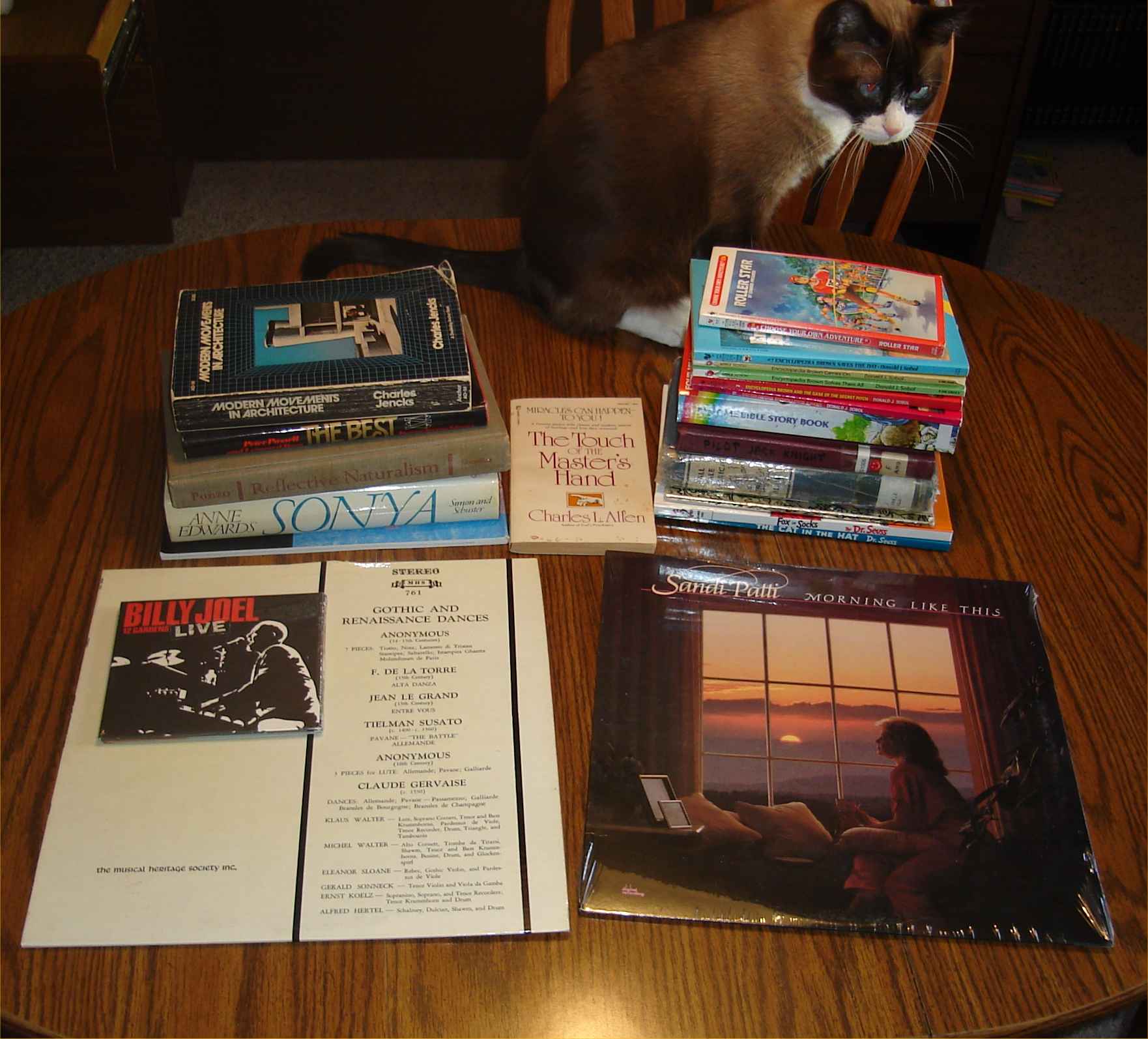
Click for full size
- An architecture handbook so I can be just like Howard once I get the orange hair dye to take.
- A book of lists (not the official The Book of Lists) about the best things.
- A smart-sounding book about Naturalism. I forget what sort.
- A biography of Tolstoy's wife.
- Some flat book I forget and am too lazy to look for.
- A promotional copy of the last Billy Joel live CD.
- A record containing some gothic and renaissance music.
That lone book in the middle was a mistake; sometime in the transfer of passing back and forth the stack of books and the boy, we picked up the book upon which we had put the stack and there it is. Now it's mine by default.
The end of yard sale season (which is November, oddly enough, here in Missouri) means we won't really go nuts buying books for a couple weeks yet until the sporadic book fairs begin again. Which gives me time to get in some reading, as you'll note below.
- posted by Brian J. @ 2:01 PM 2 comments
Book Report: Star Trek III The Search for Spock by Vonda N. McIntyre (1984)
Book Report: Star Trek III The Search for Spock by Vonda N. McIntyre (1984) As I insinuated in the book review for Star Trek II: The Wrath of Khan, this book takes the script of the movie and what I know if it and goes a little beyond it. Okay, a lot beyond it. And she's the author who gave Mr. Sulu his name, which according to Wikipedia became canon not when she used it in her book, but when it was inserted into the script of Star Trek IV: The Voyage Home.
So, do you remember the movie? Not much either you, huh? Funny how these movies are really so short in actual episodes/incidents/scenes when you come right down to it. This particular movie was the one between Khan and the whales, so it gets short shrift. Also, it reads more like a fattened television script (and the fattening isn't always flattering) than a novel in its own right. And, if you remember, this is the first movie that started the tradition of blowing up the Enterprise. Maybe it meant something in this movie (shock, if nothing else), by the time the Next Generation bunch were blowing them up like they were wooden Hollywood sets and not expensive pieces of government procurement, it was rote and boring.
So the book's worth the time if you're a Star Trek fan (or a Vonda N. McIntyre fan, I suppose).
If not, watch the movie.
- posted by Brian J. @ 2:00 PM 0 comments
Book Report: Heat by Ed McBain (1981)
Man, this book is old; Kling is still a new detective and married to the model who might have started cheating on him, The City is a pre-Giuliani cesspool, and the copyright date says 1981. Well, that's about all you can say about it to know how old the book is. Its contents and story have aged well, but it's worth remembering that this series is only middle aged here at about 30 years old.
The main plot: on the hottest week of the year, the boys from the 87th find an apparent suicide in a apartment where the air conditioner has been shut off. This causes them to delve a little deeper, and they discover that several things in the apartment have been wiped of prints--including the thermometer and the bottle of pills the victim used in the suicide. So suicide it probably ain't. In side plots, a recent ex-con decides Kling deserves to die for sending him up and Kling's investigation of the alleged infidelity of his wife.
The book's only 180 pages long, so it reads like a script for a television series in spots, but really, isn't that what we expect of these middle-of-the-series books?
- posted by Brian J. @ 1:57 PM 0 comments
Friday, January 04, 2008
Book Report: The Best Cartoons from the Saturday Evening Post edited by Steven Cornelius Pettinga (1998)
This thin volume, my free gift for subscribing or resubscribing, doesn't count for much on the intellectual scale, but you know, gentle reader, that I don't always go for the heavy stuff. As a matter of fact, I avoid it a lot of the time. So maybe some cartoons fit right in.
They're amusing. I don't think I've even chuckled at a one panel cartoon in decades, but I give some of them a wry internal smile, including some within this collection. Some almost venture to Far Side territory, something you wouldn't expect from a staid publication.
Worth a look, I guess, if you subscribe or find it at the book sales.
- posted by Brian J. @ 3:26 PM 0 comments
That's Not What I See
In the book Busy Penguins, the authors have a photo that they have captioned incorrectly:

The authors of the book are apparently unfamiliar with the penguin martial art spheniscinatasu. Instead of putting a wing around the other penguin to comfort his compatriot, the penguin on the right is in the process of employing the dreaded aptenodytesu forsterika death strike, a move that crushes the opponent's arteries to the head and leads to death within agonizing seconds.
Penguins caring, indeed.
- posted by Brian J. @ 11:10 AM 0 comments
The Sheep, Apparently, Are Outsourcing
Man rammed by bull dies of injuries
Can't the rams do the ramming, or are the bulls offering to do it less expensively? Or are St. Louis Post-Dispatch writers just that clueless to their own absurd turns of phrase?
- posted by Brian J. @ 8:45 AM 0 comments
Abrogation of Freedom Comes Easy to Some
You know why I don't tend to read the letters to the editor in the local papers? Because many of them read like this thoughtless screed, summed up with the pithy:
- Your freedom to choose ends when it impinges on my right to a clean planet.
And don't think that your freedoms would not continue being abrogated until such time as everyone achieves the same level of misery.
- posted by Brian J. @ 8:02 AM 0 comments
Thursday, January 03, 2008
Space Invaders
Some people have too much time on their hands. I remember, because when I had that time, I was skipping college classes, too.
- posted by Brian J. @ 3:18 PM 1 comments
Wednesday, January 02, 2008
When Darwin Awards and Department of Righteous Shootings Collide
Practical joke leads to cop's shooting:
- Police believe a practical joke led to the shooting Tuesday of a 23-year-old Ste. Genevieve police officer.
The rookie deputy allegedly faked a break-in around 9:45 p.m. at his brother-in-law’s home in Festus, said Festus Police Chief Tim Lewis. The brother-in-law thought an intruder was about to enter his house and reacted by shooting him.
A short time later, Festus police noticed a car speeding along Veterans Boulevard and realized the vehicle was racing to Jefferson Memorial Hospital. Once there, they recognized the shooter as an on-call minister for the police department.
- posted by Brian J. @ 9:17 PM 0 comments
That's Just Crass
 The Missouri Bar has a handy guide to keep on hand in case of nuclear detonation, river-shifting earthquake, tsunami, devastating hurricane, or apartment complex fire so that you can be sure to protect your legal rights and pay legal fees with whatever survives the looting, roving gangs, and roaming vigilantes or protection-confiscating police.
There's no point in merely surviving if you cannot sue someone, I guess.
Compare and contrast with this wisdom (link seen on Dustbury; these bits correctly inject perspective into the concept of "mass disaster," but one suspects that the light versions of mass disasters are the ones the Missouri Attorneys' special interest group / lobbying organization is most willing to help the victim through.
- posted by Brian J. @ 8:54 PM 1 comments
Meet Your New Project Manager, Clippy
Remember Clippy? Remember how you could turn him off? Well, get ready for Microsoft's Clippy the Project Manager:
- A unique monitoring system and method is provided that involves monitoring user activity in order to facilitate managing and optimizing the utilization of various system resources. In particular, the system can monitor user activity, detect when users need assistance with their specific activities, and identify at least one other user that can assist them. Assistance can be in the form of answering questions, providing guidance to the user as the user completes the activity, or completing the activity such as in the case of taking on an assigned activity. In addition, the system can aggregate activity data across users and/or devices. As a result, problems with activity templates or activities themselves can be more readily identified, user performance can be readily compared, and users can communicate and exchange information regarding similar activity experiences. Furthermore, synchronicity and time-sensitive scheduling of activities between users can be facilitated and improved overall.
- posted by Brian J. @ 1:58 PM 0 comments
Tuesday, January 01, 2008
Book Report: Friday by Robert A. Heinlein (1979)
This book is a bit unlike most genre fiction, where you have an obvious sort of plot problem that, once it's overcome, the book is done. Instead, we have a character (Friday), an elite "courier" who happens to be an Artificial Person looking for an identity in a world of humans who don't view AP or the lesser petri dish Living Artifacts as human, and we have her situation: in a post-breakup world run by batteries and without internal combustion engines, intrigue amid the nation-states, and a wave of assassinations. When Friday is rejected by an open family and is cut off from her corporate benefactors, she has to rely on her wits and her augmented reflexes to survive and find her way home.
The book is a later Heinlein; I have only the barest memory of reading anything but Stranger in a Strange Land in high school (the other stuff came in middle school) and Farnham's Freehold last year. This book is more like the former, with its reliance on free-and-breezy sexuality, than the latter, a more straight ahead science fiction story. I mean, the Heinlein moral code is there in both, but not so vigorous in the earlier work. I'm not going to spend a lot of time pooh-poohing it because I'm not a prude, but I am a family guy. So I prefer the old school Heinlein.
The book doesn't answer many questions the reader will have about what's happened between now and the time the book takes place to break up the US, for one thing, and eliminate internal combustion engines. Nor does it really draw to a close the questions it brings up nor conclude the macro-background big deals and big events in which the story is set; instead, we have Friday removing herself from the situation as a resolution.
Perhaps consistent, perhaps on message, but ultimately it weakens the book.
On the plus side, this book is fairly common at book fairs, so you can get yours cheaply if you don't want the ease and convenience of enriching me by clicking the link below.
- posted by Brian J. @ 3:34 PM 0 comments
Book Report: Star Trek: The Wrath of Khan by Vonda N. McIntyre (1982)
All right, I think this author took slightly more liberty with this novelization than "Gene Roddenberry" did with the first one; a lot of the scenes that I don't remember from the movie are a little disparate (but nobody got implants that disappear). Given what I've seen of the novelization of The Search for Spock, though, this one is relatively bang-on the novelization.
To recap: While the Enterprise is on a training mission, it investigates a scientific lab outpost that sends a garbled message to Kirk. Meanwhile, an enemy from Kirk's past has put events in motion to steal that lab's discovery and to kill Kirk in revenge.
These books clock in under 200 pages, even with the additional emoting scenes and scientific mumbo-jumbo added. If you're into Star Trek, you will probably get a kick out of them.
- posted by Brian J. @ 3:06 PM 0 comments
Book Report: Star Trek: The Motion Picture by Gene Roddenberry (1979)
As you might know, gentle reader, I picked up a number of Star Trek movie novelizations last autumn along with a copy of My Enemy, My Ally. I also later bought VHS copies of all of the movies but The Voyage Home. So I'll be able to do a comparison of the films to the novels as well, once I get around to watching the movies.
The book follows the movie, mostly, with some variations (as I recall). For example, I don't remember an implant that gives Kirk direct access to the Starfleet emergency channel. But it's in the book and, as I know of the Star Trek universe, nowhere else. However, my reading in the canon is a little light, but that's changing.
The book also looks at some of the behind-the-scenes politicking that made Kirk an admiral and some of the history of the Enterprise era, but it looks as though this, too, never made official canon. I have to wonder if they really paid attention to the books when building the movies and other series. Actually, I don't have to wonder; I can infer by what Ms. Duane said when she commented on her book.
A quick enough read, and it was fun enough. If it doesn't line completely up, I won't notice in most places and won't mind too much when it does. Which is why Paramount can do it so sloppily.
Oh, yeah, the plot: A big probe comes to earth to destroy it. No, not because of the whales, because it's Voyager coming to meet its creator and disinfect the planet of the irrational carbon units. Then, a hot bald chick acts as its emissary and the dad from 7th Heaven unites with the hot bald chick and the machine. Credits roll.
Sure, it's thin, but audiences waited through the whole 1970s, almost, to get that, and they were ecstatic. Once the geeks were happy again, the fog of the 1970s lifted, the moribund economy rebounded, and we're still seeing the effects of that national optimism today. Reagan revolution? No, the Roddenberry Revolution.
- posted by Brian J. @ 2:44 PM 0 comments
Put In My Place
Man, there's nothing better than a smuggle who visits this site through a Web search and leaves a condescending comment on a post that's several years old.
Like this one.
I mean, brother, it must be hard trying to express your biting, insightful wit on a backwater blog in a post that hardly anyone read in 2005, much less 2008.
But I publish them, oh yes, I do. Because I'm not a hater.
- posted by Brian J. @ 2:06 PM 0 comments
To say Noggle, one first must be able to say the "Nah."
"I will."
Heather L. Igert,
angelweave.mu.nu
"Genuis."
Neil Steinberg,
Chicago Sun-Times
"Some wanker."
Kim du Toit,
on the Noggle Library.
"Brian J. Noggle apparently forgot that the proper design for a tin foil beanie calls for the shiny side out."
Robb Allen,
Sharp as a Marble.
"I'm weeping openly right now. Thanks for hurting my feelings, pinhead."
Bob Rybarcyzk,
St. Louis Post-Dispatch
Instapundit
Protein Wisdom
Ace of Spades HQ
Wizbang!
Outside the Beltway
Robert B. Parker
Dustbury
Damn Interesting
Michelle Malkin
Radley Balko's The Agitator
Exultate Justi
The McGehee Zone
Signifying Nothing
The Jawa Report
Master of None
Dr. Helen
The Anchoress
Electric Venom
Kim Du Toit
Belmont Club
Little Green Footballs
Overtaken by Events
Rocket Jones
Boots and Sabers
Triticale
Ann Althouse
The American Mind
Ravenwood's Universe
Asymmetrical Information
Boondoggled
VodkaPundit
Professor Bainbridge
Virginia Postrel
Ken Jennings
Joanne Jacobs
Faster Than The World
Dilbert Blog
Junkyard Blog
In DC Journal
IMAO
Baldilocks
Powerline
Q and O
Hugh Hewitt
Buzz Machine
Daniel Drezner
Roger Simon
American Digest
Blackfive
The Volokh Conspiracy
Cold Fury
Captain's Quarters
Tim Blair
Chequer-Board
Emperor Misha
Just One Minute
Blame Bush
Inaniloquent
Trey Givens
OverLawyered
Suburban Blight
Another Rovian Conspiracy
Angelweave
Bad Example
Rachel Lucas
View from the Porch
StL Recruiting
a big victory
Spector's Hockey
Fark
/.
TechDirt
F*****d Company
CNet News
Joel on Software
James Lileks Mark Steyn Bob Rybarczyk
Richard Roeper
Neil Steinberg
John Kass
Steven Chapman
Drudge Report Ananova Slate Reason's Hit and Run
Best of the Web Today
National Review's The Corner
Tech Central Station
Fox News
CNN
Washington Post
Washington Times
Chicago Tribune
Chicago Sun-Times Milwaukee Journal-Sentinel
St. Louis Post-Dispatch
San Francisco Chronicle
New York Post
Shepherd Express
Riverfront Times
New York Observer
ScrappleFace Bob from Accounting The Onion Top Five List David Letterman's Top Ten BBSpot
U.S. Constitution
Declaration of Independence
Snopes.Com (Urban Legends)
Dictionary.com
Internet Movie Database
Complete Works of Shakespeare
Marvel Directory
Blooberry HTML Reference

Our helpful staff is ready to serve you!

Visualize World Hegemony

Cog in the Machine

Tao Sharks

Humor not displayed

Beware of Conservative
3/30/03 - 4/6/03
4/6/03 - 4/13/03
4/13/03 - 4/20/03
4/20/03 - 4/27/03
4/27/03 - 5/4/03
5/4/03 - 5/11/03
5/11/03 - 5/18/03
5/18/03 - 5/25/03
5/25/03 - 6/1/03
6/1/03 - 6/8/03
6/8/03 - 6/15/03
6/15/03 - 6/22/03
6/22/03 - 6/29/03
6/29/03 - 7/6/03
7/6/03 - 7/13/03
7/13/03 - 7/20/03
7/20/03 - 7/27/03
7/27/03 - 8/3/03
8/3/03 - 8/10/03
8/10/03 - 8/17/03
8/17/03 - 8/24/03
8/24/03 - 8/31/03
8/31/03 - 9/7/03
9/7/03 - 9/14/03
9/14/03 - 9/21/03
9/21/03 - 9/28/03
9/28/03 - 10/5/03
10/5/03 - 10/12/03
10/12/03 - 10/19/03
10/19/03 - 10/26/03
10/26/03 - 11/2/03
11/2/03 - 11/9/03
11/9/03 - 11/16/03
11/16/03 - 11/23/03
11/23/03 - 11/30/03
11/30/03 - 12/7/03
12/7/03 - 12/14/03
12/14/03 - 12/21/03
12/21/03 - 12/28/03
12/28/03 - 1/4/04
1/4/04 - 1/11/04
1/11/04 - 1/18/04
1/18/04 - 1/25/04
1/25/04 - 2/1/04
2/1/04 - 2/8/04
2/8/04 - 2/15/04
2/15/04 - 2/22/04
2/22/04 - 2/29/04
2/29/04 - 3/7/04
3/7/04 - 3/14/04
3/14/04 - 3/21/04
3/21/04 - 3/28/04
3/28/04 - 4/4/04
4/4/04 - 4/11/04
4/11/04 - 4/18/04
4/18/04 - 4/25/04
4/25/04 - 5/2/04
5/2/04 - 5/9/04
5/9/04 - 5/16/04
5/16/04 - 5/23/04
5/23/04 - 5/30/04
5/30/04 - 6/6/04
6/6/04 - 6/13/04
6/13/04 - 6/20/04
6/20/04 - 6/27/04
6/27/04 - 7/4/04
7/4/04 - 7/11/04
7/11/04 - 7/18/04
7/18/04 - 7/25/04
7/25/04 - 8/1/04
8/1/04 - 8/8/04
8/8/04 - 8/15/04
8/15/04 - 8/22/04
8/22/04 - 8/29/04
8/29/04 - 9/5/04
9/5/04 - 9/12/04
9/12/04 - 9/19/04
9/19/04 - 9/26/04
9/26/04 - 10/3/04
10/3/04 - 10/10/04
10/10/04 - 10/17/04
10/17/04 - 10/24/04
10/24/04 - 10/31/04
10/31/04 - 11/7/04
11/7/04 - 11/14/04
11/14/04 - 11/21/04
11/21/04 - 11/28/04
11/28/04 - 12/5/04
12/5/04 - 12/12/04
12/12/04 - 12/19/04
12/19/04 - 12/26/04
12/26/04 - 1/2/05
1/2/05 - 1/9/05
1/9/05 - 1/16/05
1/16/05 - 1/23/05
1/23/05 - 1/30/05
1/30/05 - 2/6/05
2/6/05 - 2/13/05
2/13/05 - 2/20/05
2/20/05 - 2/27/05
2/27/05 - 3/6/05
3/6/05 - 3/13/05
3/13/05 - 3/20/05
3/20/05 - 3/27/05
3/27/05 - 4/3/05
4/3/05 - 4/10/05
4/10/05 - 4/17/05
4/17/05 - 4/24/05
4/24/05 - 5/1/05
5/1/05 - 5/8/05
5/8/05 - 5/15/05
5/15/05 - 5/22/05
5/22/05 - 5/29/05
5/29/05 - 6/5/05
6/5/05 - 6/12/05
6/12/05 - 6/19/05
6/19/05 - 6/26/05
6/26/05 - 7/3/05
7/3/05 - 7/10/05
7/10/05 - 7/17/05
7/17/05 - 7/24/05
7/24/05 - 7/31/05
7/31/05 - 8/7/05
8/7/05 - 8/14/05
8/14/05 - 8/21/05
8/21/05 - 8/28/05
8/28/05 - 9/4/05
9/4/05 - 9/11/05
9/11/05 - 9/18/05
9/18/05 - 9/25/05
9/25/05 - 10/2/05
10/2/05 - 10/9/05
10/9/05 - 10/16/05
10/16/05 - 10/23/05
10/23/05 - 10/30/05
10/30/05 - 11/6/05
11/6/05 - 11/13/05
11/13/05 - 11/20/05
11/20/05 - 11/27/05
11/27/05 - 12/4/05
12/4/05 - 12/11/05
12/11/05 - 12/18/05
12/18/05 - 12/25/05
12/25/05 - 1/1/06
1/1/06 - 1/8/06
1/8/06 - 1/15/06
1/15/06 - 1/22/06
1/22/06 - 1/29/06
1/29/06 - 2/5/06
2/5/06 - 2/12/06
2/12/06 - 2/19/06
2/19/06 - 2/26/06
2/26/06 - 3/5/06
3/5/06 - 3/12/06
3/12/06 - 3/19/06
3/19/06 - 3/26/06
3/26/06 - 4/2/06
4/9/06 - 4/16/06
4/16/06 - 4/23/06
4/23/06 - 4/30/06
4/30/06 - 5/7/06
5/7/06 - 5/14/06
5/14/06 - 5/21/06
5/21/06 - 5/28/06
5/28/06 - 6/4/06
6/4/06 - 6/11/06
6/11/06 - 6/18/06
6/18/06 - 6/25/06
6/25/06 - 7/2/06
7/2/06 - 7/9/06
7/9/06 - 7/16/06
7/16/06 - 7/23/06
7/23/06 - 7/30/06
7/30/06 - 8/6/06
8/6/06 - 8/13/06
8/13/06 - 8/20/06
8/20/06 - 8/27/06
8/27/06 - 9/3/06
9/3/06 - 9/10/06
9/10/06 - 9/17/06
9/17/06 - 9/24/06
9/24/06 - 10/1/06
10/1/06 - 10/8/06
10/8/06 - 10/15/06
10/15/06 - 10/22/06
10/22/06 - 10/29/06
10/29/06 - 11/5/06
11/5/06 - 11/12/06
11/12/06 - 11/19/06
11/19/06 - 11/26/06
11/26/06 - 12/3/06
12/3/06 - 12/10/06
12/10/06 - 12/17/06
12/17/06 - 12/24/06
12/24/06 - 12/31/06
12/31/06 - 1/7/07
1/7/07 - 1/14/07
1/14/07 - 1/21/07
1/21/07 - 1/28/07
1/28/07 - 2/4/07
2/4/07 - 2/11/07
2/11/07 - 2/18/07
2/18/07 - 2/25/07
2/25/07 - 3/4/07
3/4/07 - 3/11/07
3/11/07 - 3/18/07
3/18/07 - 3/25/07
3/25/07 - 4/1/07
4/1/07 - 4/8/07
4/8/07 - 4/15/07
4/15/07 - 4/22/07
4/22/07 - 4/29/07
4/29/07 - 5/6/07
5/6/07 - 5/13/07
5/13/07 - 5/20/07
5/20/07 - 5/27/07
5/27/07 - 6/3/07
6/3/07 - 6/10/07
6/10/07 - 6/17/07
6/17/07 - 6/24/07
6/24/07 - 7/1/07
7/1/07 - 7/8/07
7/8/07 - 7/15/07
7/15/07 - 7/22/07
7/22/07 - 7/29/07
7/29/07 - 8/5/07
8/5/07 - 8/12/07
8/12/07 - 8/19/07
8/19/07 - 8/26/07
8/26/07 - 9/2/07
9/2/07 - 9/9/07
9/9/07 - 9/16/07
9/16/07 - 9/23/07
9/23/07 - 9/30/07
9/30/07 - 10/7/07
10/7/07 - 10/14/07
10/14/07 - 10/21/07
10/21/07 - 10/28/07
10/28/07 - 11/4/07
11/4/07 - 11/11/07
11/11/07 - 11/18/07
11/18/07 - 11/25/07
11/25/07 - 12/2/07
12/2/07 - 12/9/07
12/9/07 - 12/16/07
12/16/07 - 12/23/07
12/23/07 - 12/30/07
12/30/07 - 1/6/08
1/6/08 - 1/13/08
1/13/08 - 1/20/08
1/20/08 - 1/27/08
1/27/08 - 2/3/08
2/3/08 - 2/10/08
2/10/08 - 2/17/08
2/17/08 - 2/24/08
2/24/08 - 3/2/08
3/2/08 - 3/9/08
3/9/08 - 3/16/08
3/16/08 - 3/23/08
3/23/08 - 3/30/08
3/30/08 - 4/6/08
4/6/08 - 4/13/08
4/13/08 - 4/20/08
4/20/08 - 4/27/08
4/27/08 - 5/4/08
5/4/08 - 5/11/08
5/11/08 - 5/18/08
5/18/08 - 5/25/08
5/25/08 - 6/1/08
6/1/08 - 6/8/08
6/8/08 - 6/15/08
6/15/08 - 6/22/08
6/22/08 - 6/29/08
6/29/08 - 7/6/08
7/6/08 - 7/13/08
7/13/08 - 7/20/08
7/20/08 - 7/27/08
7/27/08 - 8/3/08
8/3/08 - 8/10/08
8/10/08 - 8/17/08
8/17/08 - 8/24/08
8/24/08 - 8/31/08
8/31/08 - 9/7/08
9/7/08 - 9/14/08
9/14/08 - 9/21/08
9/21/08 - 9/28/08
9/28/08 - 10/5/08
10/5/08 - 10/12/08
10/12/08 - 10/19/08
10/19/08 - 10/26/08
10/26/08 - 11/2/08
11/2/08 - 11/9/08
11/9/08 - 11/16/08
11/16/08 - 11/23/08
11/23/08 - 11/30/08
11/30/08 - 12/7/08
12/7/08 - 12/14/08
12/14/08 - 12/21/08
12/21/08 - 12/28/08
1/25/09 - 2/1/09
2/1/09 - 2/8/09
2/8/09 - 2/15/09
2/15/09 - 2/22/09
2/22/09 - 3/1/09
3/1/09 - 3/8/09
3/8/09 - 3/15/09
3/15/09 - 3/22/09
3/22/09 - 3/29/09
3/29/09 - 4/5/09
4/5/09 - 4/12/09
4/12/09 - 4/19/09
4/19/09 - 4/26/09
4/26/09 - 5/3/09
5/3/09 - 5/10/09
5/10/09 - 5/17/09
5/17/09 - 5/24/09
5/24/09 - 5/31/09
5/31/09 - 6/7/09
6/7/09 - 6/14/09
6/14/09 - 6/21/09
6/21/09 - 6/28/09
6/28/09 - 7/5/09
7/5/09 - 7/12/09
7/12/09 - 7/19/09
7/19/09 - 7/26/09
7/26/09 - 8/2/09
8/2/09 - 8/9/09
8/9/09 - 8/16/09
8/16/09 - 8/23/09
8/23/09 - 8/30/09
8/30/09 - 9/6/09
9/6/09 - 9/13/09
9/13/09 - 9/20/09
9/20/09 - 9/27/09
9/27/09 - 10/4/09
10/4/09 - 10/11/09
10/11/09 - 10/18/09
10/18/09 - 10/25/09
10/25/09 - 11/1/09
11/1/09 - 11/8/09
11/8/09 - 11/15/09
11/15/09 - 11/22/09
11/22/09 - 11/29/09
11/29/09 - 12/6/09
12/6/09 - 12/13/09
12/13/09 - 12/20/09
12/20/09 - 12/27/09
12/27/09 - 1/3/10
1/3/10 - 1/10/10
